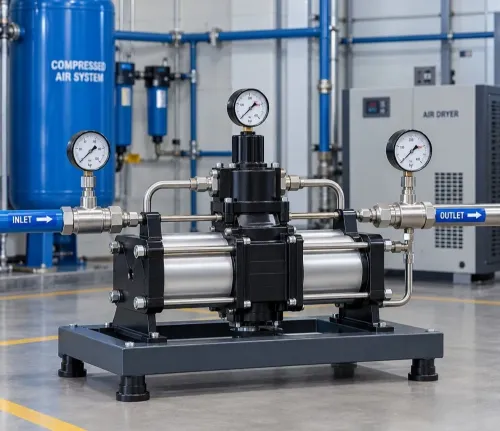

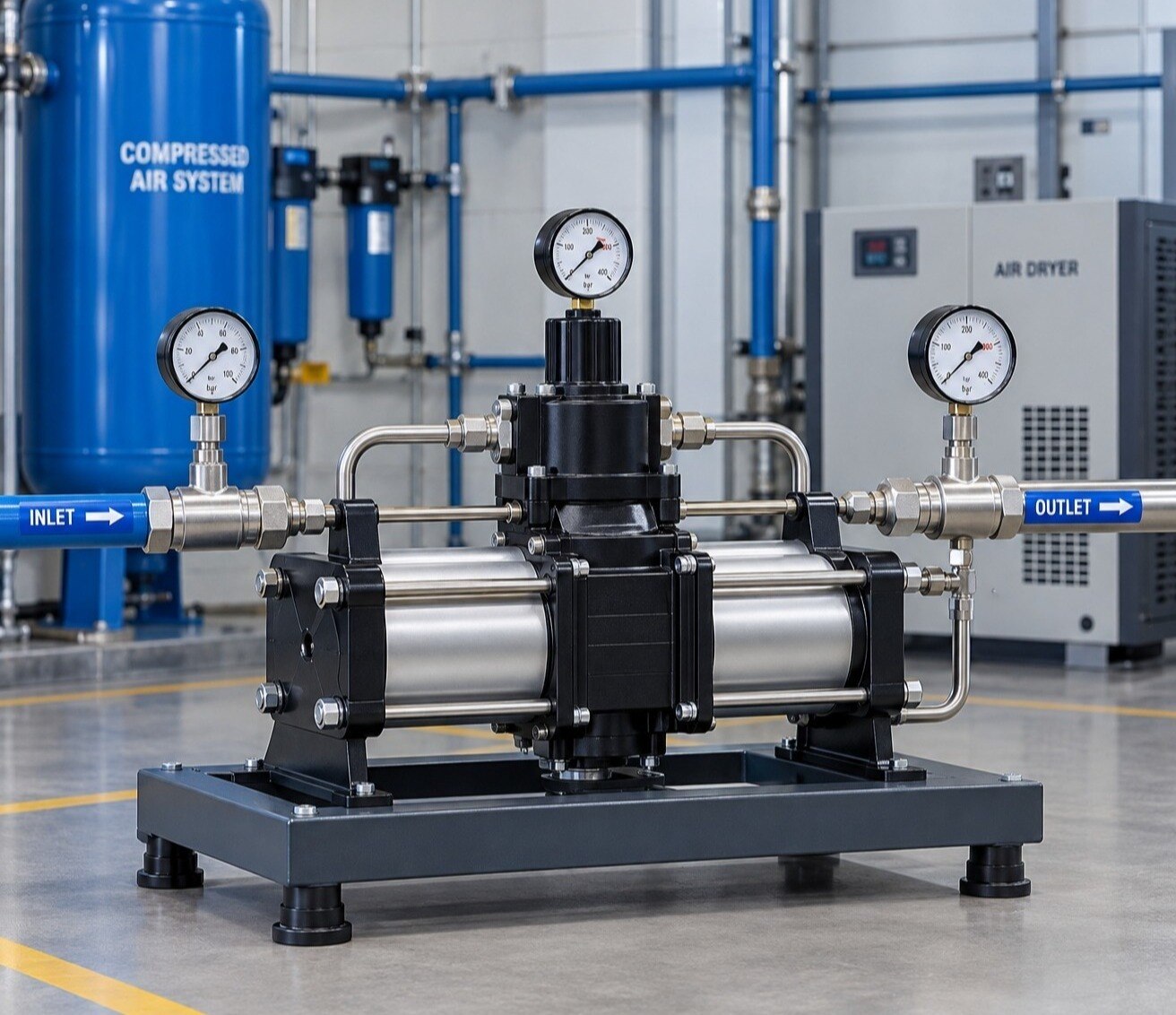
A booster raises the pressure of gas that already reaches its inlet; it cannot compensate for an undersized primary compressor, a restricted suction line, or a receiver that empties during demand peaks. You will be able to calculate the duty, compare booster designs, identify failure symptoms, and specify a safe repair and acceptance test for a Bangalore plant.
Key takeaways
- Use a booster when inlet flow is sufficient but downstream pressure is inadequate.
- Compare pressure ratio, flow, cooling, lubrication, and oil-free requirements.
- Use dedicated cleaning, seals, and safety controls for oxygen service.
- Demand leak, pressure-hold, temperature, and vibration results in the service report.
When Does a Bangalore Plant Need a Compressor Booster?
A booster is the right choice when the primary compressor already supplies enough flow, but the process needs higher pressure at a downstream point. It raises existing inlet pressure; it does not create missing compressor capacity. For high pressure air for compressor booster pump service in Bangalore, confirm these conditions before selecting equipment:
- Measure inlet pressure under load, not only during a no-demand reading.
- Define target outlet pressure and required flow in Nm³/h or CFM at that pressure.
- Check duty cycle, starts per hour, receiver volume, and downstream pressure drop.
- Review pressure-switch or PLC history for low-pressure, high-temperature, overload, and restart trips.
- Compare the result with the primary compressor’s delivered capacity and the booster’s required suction flow.
Low suction pressure, inlet pulsation, a restricted filter, or inadequate upstream compressor capacity can reduce discharge flow even when the booster is mechanically sound. A suction filter that creates excessive vacuum also reduces volumetric efficiency and makes the machine appear underpowered.
Before dismantling, record suction pressure, discharge pressure, flow, discharge temperature, running hours, and trip history. These readings separate a capacity shortage from leaking check valves, worn piston seals, or a restricted inlet. If upstream flow is inadequate, install a larger primary compressor or correct the distribution restriction; adding a booster alone will not solve it.
How Should You Compare Booster Designs and Oil-Free Options?
Choose the design from the required pressure ratio, gas, flow, and operating pattern—not from the “oil-free” label alone. A dry-running booster can still pass wear particles, seal material, assembly residue, upstream oil, or contaminated filter media.
| Design | Pressure and flow | Pulsation, cooling, and duty |
|---|---|---|
| Reciprocating piston | Medium to very high pressure; medium to high flow | Pulsation and seal wear require receivers or dampers; intercooling is essential; suitable for intermittent and selected continuous duty |
| Diaphragm | High pressure; low to medium flow | Low contamination risk and low pulsation leakage; needs diaphragm monitoring and cooling; best for clean gases and intermittent or moderate continuous duty |
| Multi-stage high-pressure designs | Very high pressure; flow depends on stages and pressure ratio | Greater cooling and control complexity; use for continuous duty only within the maker’s thermal and starts-per-hour limits |
Before specifying air booster pump maintenance or oil free gas booster service in bangalore, check:
- Maximum inlet and discharge pressure, discharge-temperature limit, gas compatibility, and allowable starts per hour.
- Nm³/h or CFM at your actual pressure ratio, not the headline free-air figure.
- Oil-free construction, particle and seal controls, inlet filtration, and point-of-use filtration.
- Oil-injected designs require separators, filters, oil changes, and carryover testing.
Write the required ISO 8573-1 particle, water, and oil class at the point of use. Use ISO 1217 for declared displacement-compressor flow and power performance. Neither standard proves a machine is oil-free.
What Changes When the Booster Handles Oxygen, Nitrogen, or Other Gases?
A booster labelled oil-free for air is not automatically suitable for oxygen, hydrogen, natural gas, or another process gas. Plan oil free gas booster service in bangalore around the gas, site conditions, and measured contamination risk—not a calendar alone.
1. Identify the gas before selecting seals or service materials. Oxygen, nitrogen, carbon dioxide, hydrogen, natural gas, and air each require separate confirmation of seal and elastomer compatibility, maximum allowable temperature, cleaning standard, ventilation, ignition-source control, electrical classification, and leak-detection method.
Oxygen service also needs oxygen-compatible cleaning; hydrogen and natural gas demand strict ignition and leak controls.
2. Check the Bangalore environment at every service visit. Record inlet-filter differential pressure, dust loading, cooling-air temperature, seasonal humidity, dew point, discharge temperature, and operating hours. Dust can choke the inlet; humid air can increase condensate and corrosion. Inspect receivers, coolers, separators, low points, and automatic drains.
A failed drain can send liquid water into the inlet or process line, so manual draining is not a reliable substitute where condensate forms continuously.
3. Verify protection before recommissioning. Set each relief valve below the maximum allowable working pressure of the component it protects, not merely below the booster rating. Provide blocked-outlet protection independent of any pressure switch or PLC. Confirm ventilation, electrical classification, leak detection, and gas-specific cleaning after maintenance.
4. Specify outlet purity separately from “oil-free.” Wear particles, seal material, assembly residue, upstream oil, and contaminated filters can still enter the gas. Define and verify the required ISO 8573-1 class at the point of use.
How Do You Diagnose and Repair a High-Pressure Booster?
Proper high pressure air compressor repair starts with operating evidence, not immediate seal replacement. Record suction and discharge pressure, flow, discharge temperature, running hours, and pressure-switch or PLC trip history before dismantling; pressure alone cannot separate a mechanical fault from inadequate upstream capacity.
Use the symptom as a fault-finding guide:
- Low outlet pressure: check worn piston rings or seals, leaking check or poppet valves, a restricted inlet filter, insufficient upstream capacity, and a relief valve that is lifting.
- Pulsation: inspect damaged valves, inadequate receiver or pulsation damping, and uneven cylinder performance.
- Overheating: check fouled intercoolers, blocked water passages, failed cooling fans, a high compression ratio, and leaking valves.
- Abnormal noise or vibration: inspect bearings, coupling alignment, loose mounts, and damaged rider rings.
- Oil carryover: check separator failure, excessive oil injection, and worn seals.
- High motor current or frequent trips: investigate overpressure, bearing drag, phase or voltage faults, and a blocked outlet.
Follow this repair checklist:
- Isolate and lock out the booster; depressurise it and verify zero pressure with a functioning gauge.
- Inspect valves, rings, seals, bearings, coolers, filters, hoses, dampers, regulators, and relief valves.
- Replace damaged parts, then leak-test and pressure-test the assembly.
- Recommission under load at the intended pressure, confirming temperatures, vibration, controls, and trip protection.
What Should a Booster Service Report and Acceptance Test Prove?
A repaired booster is ready for production only when it proves safe, achieves rated flow at the intended pressure, and passes a controlled acceptance test.
- Record before dismantling and after repair: suction and discharge pressure, flow in Nm³/h or CFM, stage and final discharge temperatures, motor current, vibration, running hours, starts per hour, dew point where relevant, drain condition, and pressure-switch or PLC trip history.
- List every replaced component, including valves, piston rings, seals, bearings, filters, and cooler parts. Record the relief-valve setting and confirm it is below the maximum allowable working pressure of the protected component.
- Run the booster loaded at its intended discharge pressure. Check capacity, temperatures, vibration, abnormal noise, motor current, and flow rather than accepting a pressure reading alone.
- Leak-test hoses, fittings, valves, coolers, receivers, and connections at operating pressure. Confirm unload, restart, high-temperature trip, and independent pressure-relief operation; a PLC or pressure switch cannot replace a relief valve.
- Inspect drains and dew point before connecting the process line. A failed drain can send liquid into the booster or distribution network.
Outlet pressure alone cannot reveal a leaking check valve, worn seal, restricted inlet filter, cooler restriction, or inadequate upstream capacity. Airprax Pneumatics LLP is useful when air booster pump maintenance or high pressure air compressor repair requires coordinated inspection, parts replacement, controls verification, and recommissioning across the booster, receiver, cooler, dryer, and network.
Use rated couplings, guarded hoses, and isolation. Never use compressed air on skin or clothing.
Related products
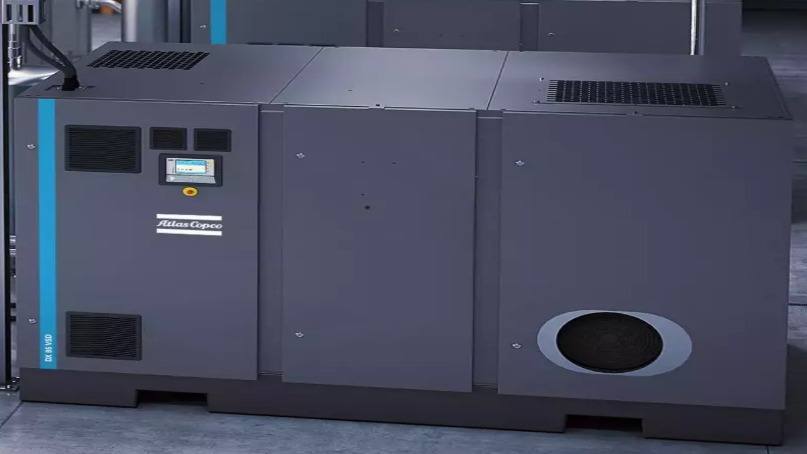 | Air Compressor Airprax Pneumatics LLP, Bangalore, offers oil-free air and gas boosters designed to efficiently increase the pressure of compressed air and gases for... View product → |
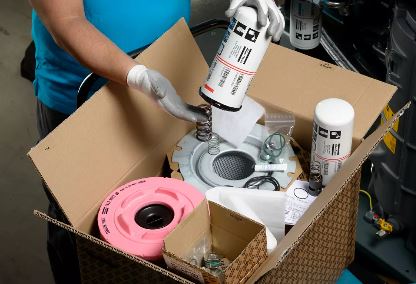 | Air Compressor Air Compressor Service and Spare Parts Airprax Pneumatics LLP, Bangalore, provides comprehensive air compressor service and spare parts solutions to help industries maintain reliable,... View product → |
Frequently asked questions
When does a Bangalore plant need a compressor booster?
Install a booster when the existing compressor provides enough flow but a downstream process requires higher pressure. A booster increases inlet pressure; it does not replace missing compressor capacity.
How should you compare booster designs and oil-free options?
Compare required inlet and outlet pressure, flow at operating pressure, pressure ratio, duty cycle, cooling, lubrication method, maintenance intervals, noise, and oil carryover limits.
What changes when a booster handles oxygen, nitrogen, or other gases?
Confirm material compatibility, cleanliness, seals, ignition controls, and gas-specific testing. Oxygen service needs oxygen-clean components and strict hydrocarbon exclusion; nitrogen service requires attention to asphyxiation and ventilation risks.
How do you diagnose and repair a high-pressure booster?
Check inlet pressure, outlet pressure, flow, temperature, vibration, unusual noise, leaks, valve condition, filters, lubrication, and drive alignment before replacing parts.
What should a booster service report and acceptance test prove?
The report should record model, serial number, work performed, replaced parts, measured pressures, flow, temperature, vibration, leak results, pressure-hold results, and acceptance limits.