
A generator rated for your average oxygen demand can still fail when a production line starts, pressure rises, or purity must stay within specification. By the end, you will be able to calculate the required flow, compare oxygen-supply methods, check Bangalore site conditions, and define a service scope that can be tested against measured plant performance.
Key takeaways
- Specify Nm³/h, oxygen purity, and outlet pressure before comparing capacities.
- Record every oxygen-use point and its peak demand before sizing the generator.
- Choose PSA, VPSA, membrane, liquid oxygen, or cylinders for the actual duty.
- Require operating-point tests, maintenance records, and defined repair response times.
Calculate oxygen demand before comparing generator capacities
Specify oxygen in Nm³/h at a stated purity and outlet pressure, not from a generator’s headline capacity. Record every point of use before comparing models.
- Required flow, oxygen purity, outlet pressure, duty cycle, and operating hours.
- Machines that run simultaneously, including the number active during the busiest shift.
- Startup surge, such as opening several cutting stations or charging a process vessel.
- Expected expansion, stated as a percentage or a defined number of future machines.
Use these records to separate demand measures:
| Measure | How to calculate | Selection use |
|---|---|---|
| Average flow | Total oxygen consumed ÷ operating time | Sizes production and storage economics |
| Peak sustained flow | Highest flow that lasts through normal operation | Sets the generator’s required output |
| Startup surge | Short-duration maximum during starting or loading | Sizes the receiver, booster, or backup |
Add a documented expansion allowance, such as two future machines or 15% additional flow. Do not guess. The generator must meet the highest sustained demand; a daily average can hide a purity collapse during the busiest period.
An oxygen receiver absorbs short peaks and reduces rapid PSA cycling, but it cannot create oxygen indefinitely. Ask for a flow-versus-purity curve at the required pressure because PSA purity normally falls above rated flow. A nameplate capacity alone cannot prove instantaneous performance.
For continuous production, specify a backup source, reserve receiver, or redundant train with automatic changeover and alarms. Buyers comparing oxygen generator sales and service in Bangalore should require simultaneous acceptance readings for flow, purity, and pressure at stable cyclic operation.
Check feed air and map the complete oxygen system
A PSA oxygen generator cannot compensate for inadequate feed air. Check the air system before approving the generator.
1. Record the compressor’s free-air delivery, discharge pressure, discharge temperature, receiver volume, and loading pattern. Compare these figures with the generator’s inlet-air demand at Bangalore’s warm, humid ambient conditions and site elevation; nominal compressor ratings can fall under those conditions.
2. Specify compressed-air quality under ISO 8573-1 with numerical limits for particles, water, and oil aerosol. “Clean compressed air” is not a specification. Record pressure dew point, liquid-water carryover, condensate-drain operation, prefilter and oil-removal filter ratings, and differential-pressure alarm limits. Liquid water, oil aerosol, and overloaded filters contaminate molecular-sieve beds and cause oxygen-purity loss.
3. Trace the equipment in order: compressor, wet or air receiver, prefilters, refrigerated or desiccant dryer, fine and oil-removal filtration, oxygen generator, oxygen receiver, booster when required, and point-of-use header. Confirm each vessel’s pressure rating, drain arrangement, bypass status, and isolation valves.
4. During industrial oxygen generator maintenance, trend oxygen purity, product pressure, feed-air pressure, pressure dew point, compressor loading, valve-cycle faults, sieve-bed differential pressure, and product-line leaks. Before blaming the generator, verify analyser calibration, dryer performance, filter differential pressure, receiver pressure, valve timing, and feed-air quality.
A contract covering only the generator cabinet excludes the compressor, dryer, filters, drains, and receivers—the equipment that can cause the failure. Require those items and their performance limits in the service scope.
Choose PSA, VPSA, membrane, liquid oxygen, or cylinders for the duty
Treat purity, flow, outlet pressure, and electrical consumption as one operating envelope. PSA systems commonly deliver 90–95% oxygen; higher purity requires a different cycle, added purification, or lower flow. Raising outlet pressure can also reduce output or require a booster and more power.
| Option | Best fit | Wrong choice when |
|---|---|---|
| PSA | Variable production demand with 90–95% oxygen and on-site generation | You need higher purity without accepting lower flow, purification, or added power |
| VPSA | Large, steady oxygen demand where vacuum equipment, floor space, and complexity are acceptable | Demand is small or intermittent |
| Membrane | Applications accepting lower oxygen concentration and simpler equipment | The process requires PSA-level purity |
| Liquid oxygen | High continuous demand with cryogenic tank, vaporiser, deliveries, and safety controls | Storage, contracts, vaporisation, or cryogenic logistics are unavailable |
| Cylinders | Low demand, temporary operation, or emergency backup | Continuous high consumption makes handling and cylinder changes excessive |
Specify oxygen at the required Nm³/h, purity, and pressure, not from a headline capacity. Ask an oxygen generator supplier in Bangalore for a flow-versus-purity curve at your outlet pressure and a power figure at that operating point.
For laser cutting, choose the gas by material, thickness, nozzle, and cutting recipe. Oxygen supports exothermic carbon-steel cutting but creates an oxidised edge and different heat-affected zone; it is not interchangeable with nitrogen. Continuous users also need automatic backup, such as cylinders, liquid oxygen, a reserve receiver, or a redundant generator train.
Prepare the Bangalore installation and prove performance at the operating point
Before delivery, approve a level floor, service clearances, forklift access, and a route for moving the oxygen receiver or other vessels. Obtain the oxygen purity certificate, flow-versus-purity curve, inlet-air quality limits, pressure rating, electrical drawings, and commissioning test format. Commission only after cyclic operation is stable; a no-load or low-flow demonstration does not prove capacity.
- Verify ambient-temperature limits, ventilation, drainage, dust and water-ingress protection, electrical voltage, connected load, and noise exposure.
- Mark an oxygen-enriched area around the generator, oxygen receiver, and distribution header. OSHA defines this atmosphere as above 23.5% oxygen.
- Provide leak response, ignition-source control, and mechanical ventilation. Use oxygen-compatible materials, oxygen-cleaned parts, compatible seals and lubricants, and controlled assembly.
- Ban oil or grease on oxygen-side connections. Test product-line leaks before introducing oxygen.
Record these values together at the specified outlet pressure and required operating point:
| Acceptance check | Record | Reject when |
|---|---|---|
| Oxygen output | Purity and flow simultaneously | Purity falls at required flow |
| Operating conditions | Feed-air pressure, pressure dew point, electrical load | Any value misses the agreed limit |
| Safety and verification | Sound level, analyser calibration status, product-line leak result | Analyser is uncalibrated or leaks remain |
This acceptance record gives oxygen generator service in Bangalore a defensible baseline. If purity is low, check analyser accuracy, feed-air pressure, dryer performance, filters, switching valves, and demand before blaming the molecular sieve.
Compare supplier scope, maintenance records, and repair response
The lowest quote for oxygen generator sales and service in Bangalore often excludes the work that determines uptime. Compare the whole service boundary, not only cabinet price: commissioning, oxygen analyser calibration, consumables, filter and dryer service, valve and seal kits, emergency visits, remote monitoring, annual performance testing, and molecular-sieve replacement or disposal.
Ask each supplier to state in writing:
- Response time for a production-stop call and escalation contact
- Automatic backup changeover, reserve capacity, alarm points, and excluded equipment
- Whether compressor, dryer, filters, drains, receiver, and product header are included
- Measured acceptance criteria for purity, flow, pressure, dew point, and electrical load
A useful maintenance record trends oxygen purity, product pressure, feed-air pressure, pressure dew point, compressor loading, valve-cycle faults, sieve-bed differential pressure, and alarms. One purity reading during a lightly loaded test cannot prove generator condition.
For oxygen generator repair in Bangalore, require technicians to verify analyser calibration, compressor discharge quality, dryer dew point, filter differential pressure, receiver pressure, valve timing, and product leaks before opening adsorption vessels or replacing sieve. Low purity can result from wet sieve, blocked filtration, excessive demand, or a leaking line.
| Service model | Main advantage | Risk to clarify |
|---|---|---|
| Cabinet-only | Lower initial price | Pretreatment faults remain excluded |
| Integrated service | One troubleshooting responsibility | Higher contract scope and cost |
| Integrated service with backup | Protects continuous production | Changeover testing and reserve sizing matter |
Oxygen generator service in Bangalore is more useful when records show trends and corrective actions, rather than isolated visit notes. Airprax Pneumatics LLP can support buyers who need compressed-air treatment, oxygen generation, commissioning, and troubleshooting under one scope.
Related product
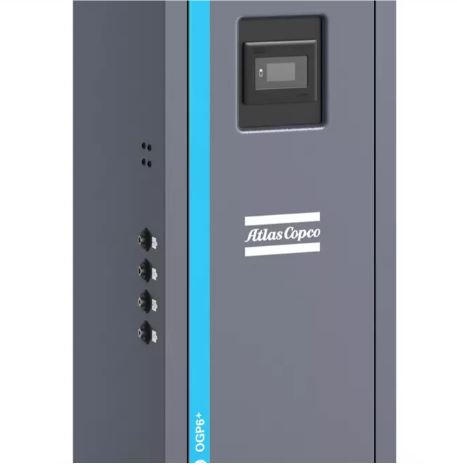 | Compressor Products Airprax Pneumatics LLP, Bangalore, offers reliable oxygen generators designed to produce oxygen on-site from atmospheric air for a wide range of... View product → |
Frequently asked questions
How do you calculate the oxygen generator capacity a facility needs?
List every point of use, record its required flow, purity, pressure, and operating schedule, then size for simultaneous peak demand rather than adding nameplate capacities alone.
What feed-air checks are needed before installing an oxygen generator?
Check compressor capacity, air quality, pressure, temperature, moisture, oil carryover, filtration, drying, receiver volume, and the complete oxygen distribution route.
Which oxygen supply method should a production facility choose?
Compare PSA, VPSA, membrane, liquid oxygen, and cylinders against required flow, purity, pressure, duty cycle, space, electricity, storage, delivery access, and backup needs.
How should a Bangalore installation be tested?
Test oxygen purity, flow, pressure, dew point, alarms, and power performance at the facility’s operating point, then record the results against agreed acceptance limits.
What should you compare when selecting an oxygen generator service supplier in Bangalore?
Compare included equipment scope, commissioning documents, preventive-maintenance intervals, spare-parts access, technician capability, service records, response times, and repair escalation.