
Boilers sized from nameplate capacity can consume fuel while useful heat leaves through condenser water, compressor coolers, wastewater, or exhaust air. By matching measured heat sources to the process temperature and duty, you can decide whether a heat pump, thermal storage system, or hybrid boiler arrangement will reduce energy use without risking production.
Key takeaways
- Profile heat demand by production interval before sizing equipment.
- Match source and process temperatures to the heat-pump lift required.
- Recover heat from cooling systems before adding external heat sources.
- Verify flow, temperatures, power use and delivered heat at commissioning.
Start with the process heat load, not the boiler nameplate
Suitability starts with an interval-by-interval heat-load profile, not the connected boiler or heater nameplate. For an industrial heat pump for process heating problems in bangalore, compare the required process temperature and flow with the available heat-source temperature across production states.
- Record supply and return temperatures, flow rates, start-up demand, batch timing, operating hours and minimum turndown at 15-minute or hourly intervals.
- Measure source streams such as warm wastewater, cooling-water return, compressor aftercooler heat, chiller condenser water and exhaust air during low, normal and peak production.
- Mark each source as clean, contaminated, corrosive, intermittent or restricted from direct discharge; contamination can require an intermediate heat exchanger or closed source loop.
- Match the timing of source and demand. If waste heat appears during cooling while heating is needed later, include a buffer tank or other thermal storage in the comparison.
The strongest case combines a stable source with a hot-water, bath or low-temperature drying load and a modest temperature lift. A larger lift raises compressor power and lowers COP.
Size the heat pump for the base load when peak batches are short; retain the existing boiler, electric heater or steam system for rapid start-up, sanitation and high-temperature peaks.
Reject the project if the source is unavailable for most operating hours, the required delivery temperature exceeds the selected machine’s range, or the recovered heat cannot be isolated safely from the process.
How the refrigerant circuit delivers useful process heat
An industrial heat pump moves heat into a factory process by circulating refrigerant through four stages.
The evaporator absorbs heat from wastewater, cooling water, exhaust air or another source; the compressor raises the refrigerant’s pressure and temperature; the condenser transfers that heat into the process-water loop; and the expansion valve drops the pressure so the cycle can repeat.
Circulation pumps move both streams, while a buffer tank absorbs short demand swings and prevents unstable compressor cycling.
Specify the temperature lift, not only the heating capacity. A source entering at 35°C and a process supply requirement of 80°C creates a 45°C lift; a larger lift raises compressor power and usually lowers COP.
At COP 3, the system supplies about three units of heat per unit of electricity, not three times a boiler’s efficiency.
For a process heat pump for factories, record these design inputs:
- Process supply and return temperatures, including the allowable temperature fluctuation
- Source inlet and outlet temperatures and flow rate at each production state
- Required heat output during startup, peak load and normal operation
- Source contamination, corrosion risk and minimum usable temperature
| Option | Indicative delivery range | When it applies |
|---|---|---|
| Hot-water heat pump | 45–90°C | Washing, drying and space or process hot water |
| High-temperature heat pump | 90–160°C | Higher-temperature drying and heating loops |
| Steam-producing system | About 120–165°C | Processes requiring low- to medium-pressure steam |
| Hybrid heat pump and boiler | Heat pump range plus boiler top-up | Loads exceeding the heat pump’s temperature or resilience limit |
Find recoverable heat where heating and cooling overlap
Start with places where rejected heat and process heating occur at the same time. Useful sources include chiller condenser-water return, compressor aftercooler discharge, cooling-tower return water, warm wastewater, condenser heat and exhaust air.
Heat pump process heating recovery works best when the source and hot-water loop or process bath operate together; otherwise, add a buffer tank or other thermal storage.
Survey each source across the factory’s operating states, not during one convenient afternoon:
- Log source temperature and flow rate during start-up, full production, idle periods and cleaning cycles.
- Record the sink’s required supply and return temperatures, batch timing, minimum turndown and peak demand.
- Measure how long the source remains available and whether its temperature falls when production changes.
- Test for oil, solids, hardness, chemicals, corrosion and cooling-tower drift. Contamination can require an intermediate heat exchanger or closed source loop.
- Separate total rejected heat from recoverable heat. Subtract heat lost through minimum approach temperatures, fouling allowance and source-flow limits.
| Source | Capture point | Survey evidence | Design implication |
|---|---|---|---|
| Chiller water | Condenser return | Temperature and flow trend | Add exchanger if water quality is poor |
| Compressor heat | Aftercooler circuit | Discharge temperature and duty cycle | Match recovery to compressor runtime |
| Wastewater | Effluent outlet | Flow, temperature and contamination | Use isolation and filtration |
| Exhaust air | Duct or stack | Air temperature, flow and dust load | Provide cleanable coils |
| Cooling tower | Return or blowdown | Water chemistry and operating hours | Protect against scaling and corrosion |
Choose between hot water, high-temperature, steam and hybrid systems
Use a hot-water heat pump when your process stays below roughly 100°C and runs for enough hours to absorb its capital cost. Washing, pasteurisation, cleaning, low-temperature drying and evaporation preheating are strong candidates because a modest temperature lift produces a higher COP.
| Option | Temperature and COP profile | Best fit | Production resilience |
|---|---|---|---|
| Hot-water heat pump | Usually below 100°C; highest COP with warm source water | Washing, pasteurisation, baths and cleaning loops | Add a buffer tank and retain peak or sanitation backup |
| High-temperature heat pump | Around 100–120°C; COP falls as the lift increases | Drying, concentrated hot-water loops and higher-temperature preheating | Keep an existing heater for rapid start-up and peaks |
| Steam-producing system | Pressurised steam duty; greater lift and lower COP than hot water | Processes that genuinely require steam above 120°C | Retain the boiler for peak demand, sterilisation or backup |
| Hybrid system | Heat pump covers base load; boiler or electric heater covers peaks | Variable schedules, mixed temperatures and uncertain source availability | Best protection against trips, monsoon source changes and shutdowns |
Choose high-temperature equipment only when the process cannot accept a hot-water loop. Replacing a steam boiler with a heat pump for a genuinely high-pressure steam duty can create inadequate output, slow recovery and excessive electrical demand.
For industrial heat pump applications in Bangalore, compare annual operating hours with the required temperature lift, not compressor capacity alone. A wastewater, cooling-water or process-return source gives steadier performance than humid outdoor air; monsoon fouling, corrosion and wet-coil pressure drop must be planned. A hybrid arrangement usually wins when production cannot tolerate a heat-pump trip.
Commission the system around measurable performance
A falling COP is a measurement problem before it is a refrigerant problem. During selection, record source and sink temperatures, flow rates, operating hours, and electrical demand at every production state—not only during a convenient afternoon survey.
At commissioning, require acceptance data at the specified source and sink conditions. Compare delivered heat, compressor power, and calculated COP with the supplier’s guaranteed values; a catalogue COP measured at unrelated temperatures proves little.
- Measure source-inlet and source-outlet temperatures, plus source-side flow.
- Measure sink-inlet and sink-outlet temperatures, plus process-loop flow.
- Record compressor electrical power, suction pressure, discharge pressure, and delivered heat.
- Calculate heat output from flow, fluid properties, and temperature difference; calculate COP as useful heat divided by electrical input.
- Trend temperature approach and differential pressure across strainers and heat exchangers.
For industrial heat pump troubleshooting, check water flow and approach temperatures before opening the refrigerant circuit. Fouled plates, filters, evaporator coils, air or non-condensables, incorrect charge, excessive condensing temperature, and a colder or smaller source stream can all reduce capacity while leaving the compressor apparently healthy.
Trend these values through start-up, peak production, cleaning cycles, and shutdown. Give Airprax Pneumatics LLP the same time-stamped data if it is supporting commissioning or fault-finding; it lets the technician separate a control problem from fouling, hydraulic restriction, or an undersized heat source.
Related product
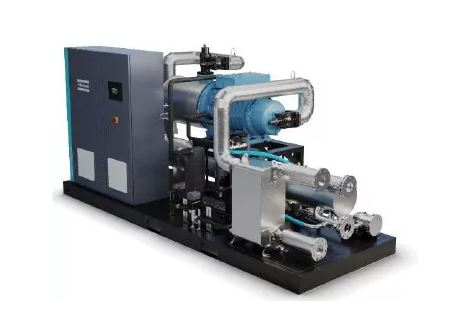 | Compressor Products Airprax Pneumatics LLP offers a range of high-performance Industrial Heat Pumps engineered to deliver reliable, energy-efficient thermal solutions... View product → |
Frequently asked questions
Why should you start with the process heat load instead of the boiler nameplate?
A boiler nameplate shows connected capacity, not actual demand. Build an interval-by-interval profile using process temperature, flow, operating hours and production states.
How does an industrial heat pump deliver useful process heat?
The refrigerant circuit absorbs heat at the evaporator, raises its temperature and pressure through the compressor, then releases heat at the condenser to process water, air or another heating medium.
Where can factories find recoverable heat?
Check cooling towers, chilled-water return lines, air compressors, refrigeration systems, dryer exhaust and warm wastewater for heat that overlaps with heating demand.
How do you choose between hot-water, high-temperature, steam and hybrid systems?
Choose hot-water systems for moderate temperatures, high-temperature systems for hotter process streams, steam systems when direct steam is essential, and hybrid systems when heat pumps cannot cover the full load.
What should commissioning measure?
Record source and delivery temperatures, flow rates, compressor power, delivered heat, control response and performance across representative production conditions.