
Ancillaries fail when they are selected from the chiller’s nominal tonnage instead of the site’s actual heat load, flow, pressure, temperature, and operating conditions. By the end, you will be able to calculate the process flow, specify pumps, pipes, tanks, heat exchangers, filtration, controls, and heat-rejection equipment, then compare quotations on the same technical basis.
Key takeaways
- Use Bangalore design dry-bulb and wet-bulb values, not annual averages.
- Build a heat-load schedule covering every process, operating state and future expansion.
- Select pumps and pipes at the actual flow, head and control duty point.
- Compare suppliers using guaranteed flow, temperature, power, redundancy and heat-rejection data.
Start with the Bangalore design condition and a complete heat-load schedule
Start with Bangalore’s design dry-bulb and wet-bulb temperatures, not annual averages. How to size industrial chiller ancillaries in Bangalore depends on the specified design percentile and actual site elevation: wet bulb and approach govern cooling-tower performance, while dry bulb governs an air-cooled condenser.
1. Define the process duty. Record each machine or product’s heat input, operating hours, chilled-water supply and return temperatures, allowable temperature rise, peak demand, and required production continuity.
2. Build a complete heat-load schedule in kW and TR. Include product heat, motor and drive heat, heat entering from the ambient, solar gains, pipe and tank losses, heat from pumps and auxiliaries, and any compressor power that the heat-rejection system must discharge.
3. Separate running, startup, and simultaneous loads. State the diversity assumption instead of adding every nameplate rating; otherwise pumps, heat exchangers, towers, and electrical equipment become unnecessarily large.
4. Add the project’s stated safety margin and show the calculation behind it. Record the resulting evaporator load, total heat-rejection load, design operating hours, and allowable temperature limits.
This schedule becomes the reference for flow, pump head, heat-exchanger area, filtration, and heat rejection. Without it, ancillary quotations are not technically comparable.
Convert cooling load into process flow and choose the hydraulic arrangement
An 80 kW process load requires 3.83 kg/s of water at a 5°C design rise, or about 13.8 m³/h. Calculate it with Q = m × Cp × ΔT: mass flow m equals load Q divided by fluid specific heat Cp and allowable temperature rise ΔT.
For water, Cp is about 4.18 kJ/kg·K; 1 TR equals 3.517 kW. For glycol, use its actual Cp and density before converting mass flow to volume flow.
Base the calculation on the process return temperature and allowable rise, not merely the chiller leaving-water set point. A machining line needing 18°C and a laser requiring 12°C should not share one uncontrolled loop. Choose the arrangement that matches the process:
| Process condition | Hydraulic arrangement | Reason |
|---|---|---|
| Same temperature and cleanliness | Common loop | Simplest pumping and control |
| Different temperatures | Secondary loop with heat exchanger | Protects each set point |
| Contaminated or incompatible fluid | Isolated heat-exchanger loop | Keeps the chiller circuit clean |
Check the chiller’s documented minimum evaporator flow before using variable primary flow. Add a bypass or decoupler so staging cannot starve it. In an open cooling-tower circuit, calculate condenser flow from rejected heat, not evaporator load alone: Q = m × Cp × ΔT includes compressor power.
Include strainers, heat exchangers, and side-stream filtration in the process cooling support equipment duty.
Size pumps, pipes, and flow controls from the actual duty point
A pump with the required flow but insufficient total dynamic head will starve the chiller or tower. Select the duty point from the actual design flow and the pressure losses across the complete circuit, not from nominal chiller tonnage.
- Add friction loss in supply and return pipes.
- Add losses through the chiller, cooling tower or heat exchanger.
- Add pressure drops across valves, strainers, filters, and control valves.
- Add static lift where the circuit is open or has a real elevation requirement; elevation does not add net head in a closed loop.
- Check the pump curve at the design duty point, including motor input and efficiency.
Choose pipe diameter by calculating velocity and friction loss at that flow. A pipe that is too small creates noise, erosion, and excessive pump energy; an oversized pipe increases cost and can weaken control authority. Compare both options at the calculated duty point.
Use the pump arrangement that matches production risk:
- One pump suits a noncritical process that can stop for maintenance.
- Duty-and-standby pumps suit a production-critical chiller; provide automatic changeover and isolation valves.
- Staged parallel pumps suit variable load, provided each pump remains stable at reduced flow.
Set minimum-flow control to the chiller manufacturer’s documented limit. Use a bypass or decoupling arrangement and sequence valves so evaporator flow never falls below that value during unloading or staging. Document these conditions in industrial chiller accessories sizing comparisons.
Specify tanks, strainers, filters, valves, sensors, and water treatment together
Size the buffer tank from the allowable chilled-water temperature swing, required minimum compressor run time, and load during that interval—not from chiller capacity alone. Use V = P × t ÷ (ρ × Cp × ΔT) as the starting energy balance, then check the result against the chiller’s control sequence.
A tank that is too small causes rapid cycling; an oversized tank adds cost without improving stability.
Size the expansion tank from total closed-loop volume, minimum and maximum fluid temperatures, fluid expansion coefficient, pre-charge, and relief pressure. Glycol needs more volume than water for the same temperature range. Confirm the tank’s acceptance volume, not merely its nominal vessel size.
Specify cooling system ancillaries for factories with these duty values:
- Strainers and filters: design flow, mesh or micron rating, clean and dirty pressure drop, fouling allowance, and isolation for cleaning.
- Side-stream filtration: circulation fraction or turnover target tied to basin volume, particle size, solids loading, and treatment limits.
- Valves: full-flow pressure drop, shutoff rating, control range, and fail position.
- Sensors: supply and return temperature, differential pressure, flow, tank pressure, conductivity, and low-level alarms at measurable locations.
- Water treatment: hardness, corrosion, biological-control limits, dosing method, and test frequency.
Place air and dirt separation near the circulator’s low-pressure side and point of no pressure change.
Match heat rejection, electrical capacity, and redundancy to site conditions
A cooling tower must reject the chiller’s evaporator load plus compressor input power, not the nominal refrigeration tons alone. Calculate condenser-water flow with Q = m × Cp × ΔT, then select the tower against the design wet-bulb temperature, approach, fouling allowance, and 900–950 m site elevation.
For an air-cooled condenser, use the design dry-bulb temperature and altitude-corrected fan airflow; lower air density in Bangalore can reduce heat-rejection capacity.
State these values on the equipment schedule:
- Entering-water temperature, leaving-water temperature, water flow, design wet bulb, approach, and altitude for a cooling tower
- Design dry bulb, refrigerant condensing condition, fan airflow, fan motor kW, and sound limit for an air-cooled condenser
- Running current, locked-rotor or starting current, feeder size, breaker rating, transformer capacity, and voltage drop for each motor
Check the electrical system at simultaneous operation, including chillers, pumps, tower fans, controls, and treatment equipment. Confirm the generator or alternate supply can start the largest motor and carry the running load without unacceptable voltage sag.
For a critical process, use duty/standby or N+1 chillers, pumps, and control components with automatic changeover and isolation valves. The standby arrangement is not redundant if a shared header, tower, or electrical feeder cannot carry the full design duty.
Use a guaranteed equipment schedule to compare Bangalore suppliers
Do not accept a quotation that gives only model numbers and cooling capacity. Ask every chiller ancillary equipment supplier in bangalore for a guaranteed equipment schedule tied to your site design percentile, actual elevation, and operating conditions; otherwise pump, tower, filter, and heat-exchanger prices are not technically comparable.
Request these values for each item:
- Design flow, total pressure drop, duty point, turndown, minimum flow, and control range
- Cooling-tower entering-air wet-bulb and approach, or air-cooled condenser dry-bulb condition
- Site altitude, sound level, motor input, running and starting current, supply voltage, and short-circuit rating
- Water-quality limits, filtration rate, particle size, solids loading, chemical-treatment assumptions, and basin volume
- Required maintenance clearances, connection sizes, isolation valves, spare-parts scope, and warranty exclusions
- Duty/standby or N+1 capacity, automatic changeover, and whether the common header and heat-rejection equipment support the standby unit
Compare the schedule rather than the brochure:
| Parameter | Acceptable quotation | Reject or clarify |
|---|---|---|
| Air condition | Design wet bulb or dry bulb plus percentile and altitude | “Bangalore ambient” only |
| Flow performance | Guaranteed flow and pressure drop at duty point | Pump nameplate flow alone |
| Electrical demand | Running, starting, fan, pump, VFD harmonic, and control loads | Refrigeration kW alone |
Airprax Pneumatics LLP can be asked to document these boundary conditions before you compare its proposed cooling ancillaries with alternatives.
Related products
 | Industrial Chillers Ancillaries For Industrial Cooling Airprax Pneumatics LLP, Bangalore, provides a comprehensive range of ancillaries for industrial cooling systems, designed to support efficient,... View product → |
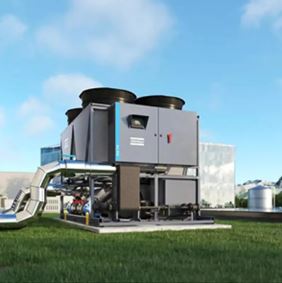 | Industrial Chillers Airprax Pneumatics LLP, Bangalore, provides industrial water chillers designed for efficient and reliable process cooling in a wide range of... View product → |
Frequently asked questions
Which Bangalore climate values are needed to size chiller ancillaries?
Use the specified design dry-bulb and wet-bulb temperatures, design percentile and site elevation. Wet bulb and approach affect cooling-tower performance, while dry bulb affects air-cooled condenser capacity.
How do you convert a process cooling load into flow?
Use the required cooling load, fluid heat capacity and permitted supply-to-return temperature difference. Confirm the result against each machine’s minimum and maximum flow range.
How should pumps and pipes be sized for an industrial chiller?
Select them from the actual duty point: required flow, static head, friction loss, equipment pressure drop and control range. Check the pump curve at the expected operating point.
What ancillary equipment belongs in the cooling system specification?
Specify tanks, strainers, filters, isolation and control valves, sensors, expansion provisions and water treatment with the chiller. Their sizes and materials must match fluid quality, temperature and flow.
What should you compare when selecting a Bangalore chiller supplier?
Request a guaranteed equipment schedule covering cooling capacity, leaving and entering temperatures, flow, pump head, electrical load, heat rejection, sound, footprint and redundancy.
Related products
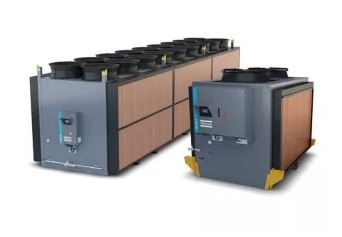 | Industrial Chillers Airprax Pneumatics LLP, Bangalore, offers the TDV Dry Coolers Series, designed to provide efficient and reliable heat rejection for industrial... View product → |
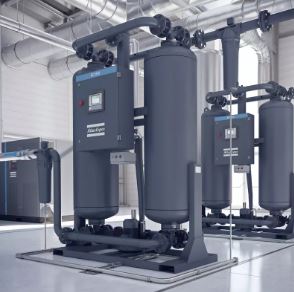 | Compressor Products Airprax Pneumatics LLP, Bangalore, provides high-performance air dryers designed to remove moisture and water vapour from compressed air systems,... View product → |
 | Compressor Products Airprax Pneumatics LLP, Bangalore, offers advanced Industry 4.0 controllers designed to transform conventional industrial equipment into intelligent,... View product → |