
The investment pays off when repeated production work is losing more time to handling, setup, sorting, and waiting than the automated cell costs to remove. By measuring your actual workload, utilities, floor constraints, labour use, and good-parts output, you can decide whether to automate now, phase the project, or improve manual processes first.
Key takeaways
- Count labour, throughput, scrap, downtime, and financing in your ROI model.
- Automation suits repeatable production with high machine utilisation and predictable material flow.
- Verify integration scope, floor space, service response, and software responsibilities in writing.
- Run a paid or witnessed production test before signing the equipment contract.
What TRUMPF automation actually automates
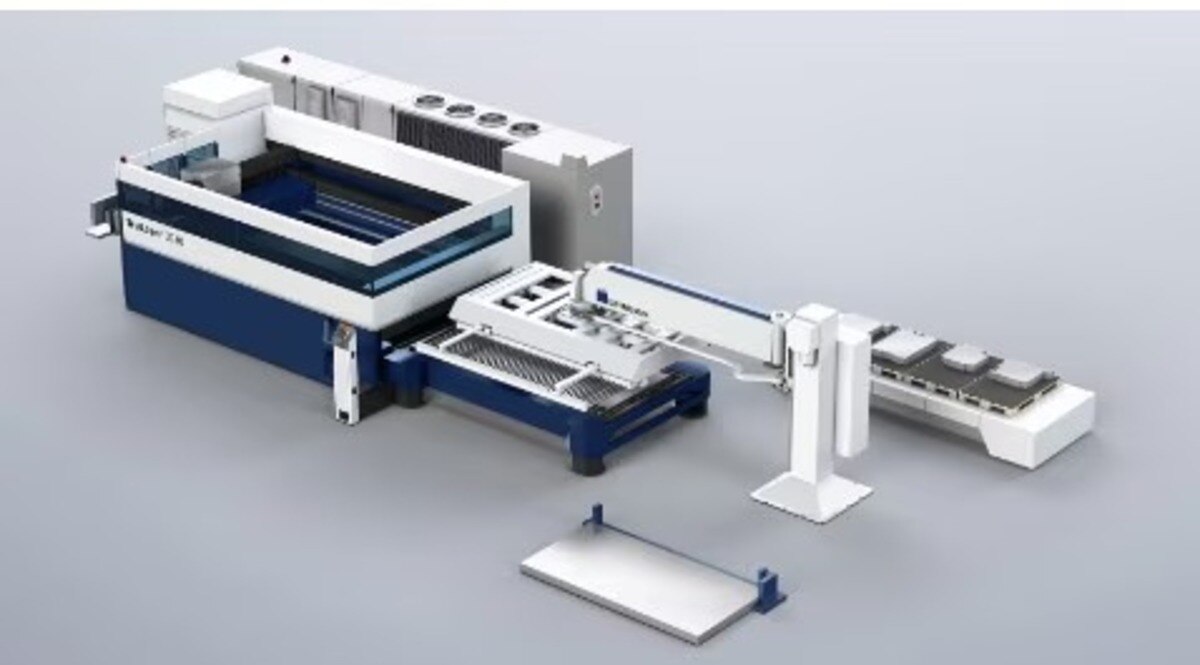
A complete automated TRUMPF cell does more than cut sheet; it manages material flow from storage to finished parts. It can load raw sheets, unload cut parts, sort components, move pallets, change punching or bending tools, and store usable remnants.
Production software can connect laser cutters, punch-laser machines, punching machines, press brakes, and storage towers through job, program, and material data.
Compare the purchase boundary before judging the price:
| Option | What it includes | Main limitation |
|---|---|---|
| Full automation | Storage tower, loaders, unloaders, conveyors, pallet exchange, sorting, safety fencing, and software tracking | Higher capital cost, floor-space demand, and integration work |
| Semi-automatic loading | Assisted sheet loading or pallet exchange | Operators still move parts, remnants, or pallets |
| Manual or forklift handling | Machine bought without automatic loading and unloading | Lower initial cost, but more touch time and traffic |
| Standalone storage | Sheet tower without connected production equipment | Stores material but does not coordinate cutting, sorting, or scheduling |
A cell must be assessed as a material-flow system. Conveyor length, pallet exchange, barcode or program tracking, guarding, operator access, inspection points, forklift aisles, ceiling height, slab loading, and fire access affect both output and installation cost.
Automated TRUMPF sheet-metal equipment in Bangalore can underperform if incoming sheets, remnants, finished parts, and pallets cannot move without crossing each other.
Automation removes repeatable handling and coordination tasks, not production discipline. Missing drawings, poor nests, unplanned engineering changes, weak scheduling, and inconsistent part numbers will leave an expensive cell waiting. A machine-only purchase, standardised handling, or phased storage upgrade can suit a low-volume, high-mix shop better.
How to calculate the return on investment
The relevant question is whether TRUMPF automation is worth it for manufacturers in Bangalore, based on saleable output rather than advertised laser or bending speed. Measure one month of actual production before modelling the purchase:
- Monthly sheets, good parts per occupied hour, machine utilisation, setup minutes, operator touch time, queue time, scrap, rework, overtime, work-in-progress, unplanned downtime, and contribution margin per good part.
- Labour hours saved, added good-part capacity, shorter changeovers, scrap reduction, and lower WIP as separate benefits.
- Maintenance, software, utilities, financing, integration, training, floor space, and installation as separate costs.
Test each shift pattern with production that customers will buy, not theoretical capacity.
| Pattern | Include in the model | Decision test |
|---|---|---|
| One shift | Planned changeovers, existing orders, day-shift labour | Buy only if labour, scrap, and setup savings create an acceptable payback |
| Two shifts | Night production, supervision, gas consumption, maintenance windows | Count added capacity only when confirmed demand converts it into good parts |
| Three shifts | Unattended hours, backup supply, overtime avoided, stoppage response | Require realistic uptime and a credible order book, not maximum machine speed |
Include nitrogen or oxygen purity, pressure, flow, duty cycle, cylinder or bulk-gas rental, generator electricity, buffer storage, compressor and dryer power, chiller power, and backup supply. Higher utilisation has no financial value when it produces excess stock, rejects, or idle parts awaiting downstream work.
Compare the investment with contribution from additional good parts and calculate payback after financing and integration. Test 12-, 24-, and 36-month scenarios. If the model fails, standardised loading, quick-change tooling, offline programming, storage, or semi-automatic handling may deliver a better return.
Which production conditions justify the investment
Automation earns its keep when the same part families consume machine time across multiple shifts and operators repeatedly move sheets, pallets, remnants, and finished parts. High utilisation, stable nests, predictable orders, and a genuine need for unattended night production support the investment; low utilisation does not.
| Option | Best fit | Main risk |
|---|---|---|
| Standardised manual loading | Moderate volume, short travel distances | Labour remains tied to the machine |
| Forklift handling plus standalone storage | Large sheets and flexible job mix | Forklift time and aisle congestion |
| Quick-change tooling and offline programming | Short runs and frequent setups | Handling bottlenecks remain |
| Semi-automatic loading | Growing volume with limited capital | Less unattended capacity |
| Full TRUMPF cell | Repeatable families, multiple shifts, stable scheduling | High capital and floor-space exposure |
A low-volume, high-mix job shop with one-off parts, frequent engineering changes, limited floor space, weak planning, or insufficient working capital should improve process control before buying a full cell. The trumpf automation benefits in bangalore question has a practical answer: measure recovered productive hours, not brand preference or a new machine’s specification.
Use a phased route to limit risk:
- Standardise part numbers, revisions, nests, and tooling; then measure the bottleneck.
- Automate loading or storage before adding sorting, bending, or connected scheduling.
- Compare the result with automation from another machine manufacturer using good parts per occupied hour.
If programs arrive late or material flow is unreliable, automation only makes an expensive waiting system.
What to verify before requesting a proposal
Send the supplier a production file and measured site data, not an equipment wish list. Automated TRUMPF sheet-metal equipment in Bangalore must fit your actual material flow, utilities, software, and floor plan.
1. Record monthly sheet volume; mild-steel, stainless-steel, and aluminium grades; thicknesses; sheet dimensions; part mix; nest patterns; cycle times; changeover frequency; shift hours; queue time; labour allocation; rejected parts; remnants; and available floor area.
2. Map compatibility with existing TRUMPF laser cutters, punch-laser machines, punching machines, press brakes, pallets, part geometries, material-thickness limits, software, revision control, and barcode traceability. Identify programs that require manual intervention.
3. Measure the proposed installation point during representative shifts: incoming voltage and frequency, phase imbalance, voltage dips with a power-quality logger, earth continuity, and short-circuit level. Record compressed-air pressure and flow at peak simultaneous demand, plus ISO 8573-1 particle, water, and oil classes, filtration, and pressure-dew-point.
4. Survey cooling-water or chiller capacity, floor loading, slab flatness, ceiling height, crane or rigging access, aisle width, forklift routes, fire protection, safety guarding, emergency-stop zoning, light curtains or scanners, and operator access.
5. Specify backup gas, required gas purity, purity monitoring, automatic changeover, and recovery after power, gas, air, or cooling failure. Draw the routes for sheets, pallets, remnants, finished parts, forklifts, and inspection; a tower that blocks those routes becomes a new bottleneck.
How to test a supplier’s promise before signing
A quotation earns approval only after the supplier proves output on your parts, under your utilities, with recovery and safety documented. Treat a TRUMPF machine automation supplier in Bangalore as responsible for the complete cell, not just the machine.
1. Require a factory acceptance test using actual sheet grades and thicknesses, mixed nests, small parts, remnants, planned loading times, changeovers, and the intended shift pattern. Reject a demonstration based only on advertised cutting speed.
2. Record good parts per occupied hour, scrap, first-off inspection results, loading and changeover time, program and barcode traceability, remnant handling, and recovery from a material jam. Measure the result against the payback model, not OEE alone.
3. Repeat the agreed test as site acceptance testing after installation. Use the factory’s actual power, compressed-air pressure and quality, gas supply, cooling capacity, floor flatness, and access conditions; a cell that passes in a showroom can fail on your utilities.
4. Require safety validation for interlocked guards, access gates, light curtains or scanners, emergency-stop zones, safe restart, robot or shuttle collision protection, and jam-recovery procedures. Reference ISO 13849-1 and IEC 60204-1, and request the validation record.
5. Put preventive-maintenance intervals, operator training, remote diagnostics, response time, critical spare-part stocking, stoppage escalation, software fees, integration scope, and warranty exclusions in the commercial schedule. A local address does not prove local parts or support.
6. If local installation, utility verification, maintenance, or integration needs scrutiny, assess Airprax Pneumatics LLP against those written obligations. Approve the project only when measured acceptance criteria produce an acceptable payback.
Related products
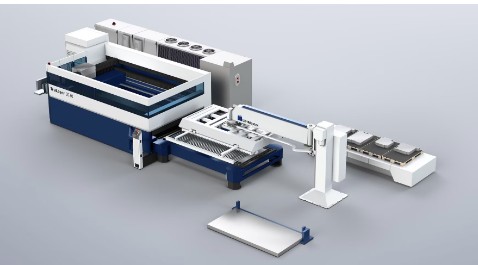 | TRUMPF Products Automation Airprax Pneumatics LLP, Bangalore, offers Trumpf make Automation solutions designed to improve productivity, precision, reliability, and overall... |
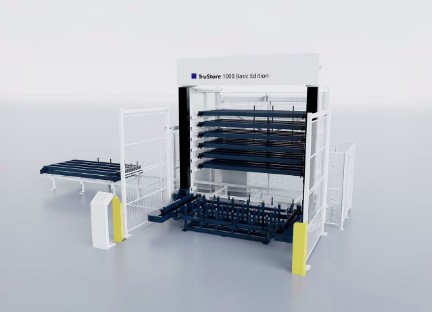 | TRUMPF Products Airprax Pneumatics LLP, Bangalore, offers Trumpf make Storage Systems designed to provide efficient, organized, and automated storage solutions for... View product → |
Frequently asked questions
What does TRUMPF automation actually automate?
A complete cell can load raw sheets, unload cut parts, sort components, move pallets, change tools, and store usable remnants.
How do you calculate the return on investment for TRUMPF automation?
Compare the total installed cost with annual savings from labour, throughput, scrap, setup time, downtime, and added production capacity.
Which production conditions justify TRUMPF automation?
Look for repeatable jobs, high machine utilisation, frequent material handling, stable demand, and enough floor space for storage and transfer equipment.
What should you verify before requesting a TRUMPF automation proposal?
Prepare material sizes, weights, job mix, shift pattern, throughput targets, floor plan, utilities, software needs, and integration responsibilities.
How can you test a supplier’s automation promise before signing?
Witness representative jobs, request measured cycle times, inspect reference installations, define acceptance tests, and document service-response commitments.