
The right choice depends less on a machine’s headline power than on the joint you must produce, the variation your parts contain, and the finish your customer will accept. You will be able to match materials, thicknesses, joint geometry, production demands, and cell features to a practical laser or arc-welding decision.
Key takeaways
- Choose laser welding for accurate joints, speed and low distortion.
- Choose arc welding for gaps, large fillets and heavy sections.
- Test thickness, joint fit-up and material preparation before selecting equipment.
- Specify fixturing, extraction, controls and safety systems with welding power.
How laser welding and arc welding differ in production
Laser welding delivers the better result when a clean, accurately located joint needs high speed, deep penetration, a narrow heat-affected zone and little distortion. Arc welding delivers the better result when gaps, large fillets or heavy sections demand a larger weld pool and substantial filler metal. That is the central industrial laser welding comparison.
| Process | Production advantage | Production limitation |
|---|---|---|
| Laser | Fast travel, deep keyhole penetration, smooth bead, low spatter and low distortion | Requires accurate focus, tight fit-up, clean surfaces, stable shielding and repeatable part location |
| MIG/MAG | High filler deposition, broad process window and good gap tolerance | Higher heat input, spatter, wire and gas consumption, and more finishing |
| TIG | Clean, controlled bead with excellent appearance | Slow deposition and high operator-skill demand |
| Flux-cored arc | Handles heavy sections, variable gaps and high joint volume efficiently | More smoke, slag or spatter, plus greater heat and cleanup |
Laser shielding gas use can be lower than arc welding, but a contaminated nozzle, protective window or unstable gas stream can cause porosity and incomplete fusion. Arc welding tolerates less precise edge preparation because wire bridges gaps; laser welding becomes difficult when gaps vary or filler volume is high.
Choose arc welding for inconsistent castings, large fillets and repair work. Choose laser for repeatable thin-sheet joints where low heat and minimal finishing matter; otherwise arc welding becomes inefficient rather than forgiving.
Neither process removes the need for skilled setup: laser operators control focus and fixturing, while arc operators manage torch angle, travel and filler deposition.
Match the process to the metalwork application and production pattern
Choose an arc welding cell for large sections, variable access, heavy fillets, inconsistent castings, or repair work; choose a laser system for thin, repeatable joints where fit-up and presentation stay tightly controlled.
1. Select an arc welding cell for automotive components, frames, cabinets, brackets, machinery assemblies, structural fabrications, and pressure-component attachments. MIG/MAG or flux-cored welding adds filler efficiently to large fillets, gaps, and thick sections. A robot improves repeatability, torch reach, deposition rate, and cycle consistency across repetitive fillet or butt welds.
2. Select laser welding for thin stainless-steel sheet, aluminium panels, tailor-welded blanks, tight-tolerance butt joints, cosmetic seams, and heat-sensitive assemblies. Its concentrated heat source supports low distortion and reduced finishing when the joint is continuous, accessible, clean, accurately fixtured, and consistently located.
3. Compare laser welding versus arc welding against the actual production pattern. High volume and a stable fixture favour laser processing; small batches, frequent changeovers, changing access, or repair work favour an arc cell. A laser is not automatically faster on thick steel if bevels, multiple passes, filler wire, or hybrid equipment become necessary.
4. Before choosing, record material, thickness, joint geometry, tolerance, batch size, required weld finish, and joint volume. Choose arc welding when gaps or edge variation exceed a laser process window; choose laser when repeatable part location and a narrow, clean seam matter more than filler-metal deposition.
Set thickness, joint fit-up, and material preparation before choosing
Set the allowable gap by a process trial, not a universal number. Check edge mismatch, square and clean edges, seam location, and the clamping force needed to hold them. A repeatable fixture matters because a laser keyhole can become unstable when the gap or focus position changes along the seam.
| Laser | Tight gap and edge control; concentrated keyhole | Thin, continuous, accessible joints with repeatable fixturing |
|---|---|---|
| Arc | Larger weld pool; filler wire and multiple passes | Thick or gapped sections, changing assemblies, and repair work |
An industrial laser welding comparison should include what happens beyond the nominal power rating. If a laser-only joint exceeds its qualified gap window, expect burn-through, incomplete fusion, porosity, or repeated repair. Filler wire, a bevel, or multiple arc passes can bridge variation and make an arc cell the more practical choice for thick sections.
Prepare every surface before either process. Remove oil and moisture; strip oxide from aluminium; control zinc on galvanised sheet; and prevent trapped contamination in stainless-steel joints. These defects release gas, causing porosity, spatter, or unstable penetration.
Copper and aluminium also reflect near-infrared energy, so coupling and back-reflection require validation; trial green or blue laser sources for demanding copper work, without treating them as a qualification shortcut.
Specify the complete welding cell, not just laser or arc power
1. Specify the complete cell, not only source power. For a laser, record wavelength and power, optics, focus control, wire-feed capability, protective-window cleaning and replacement, seam tracking, vision, work envelope, robot or gantry reach, programming method, laser guarding, interlocked access, beam containment, fume extraction, and shielding-gas delivery.
2. For an arc cell, specify the MIG/MAG or TIG power source, torch access, wire and gas delivery, positioner capacity, cable routing, fume extraction, UV/IR arc-radiation controls, and recovery steps after a failed weld.
Nominal robot payload is insufficient: the torch or processing head, fibre and cable bend limits, fixtures, calibration, and changeover access determine whether the robot can reach and repeat the weld.
3. Qualify both processes on the actual material combination, thickness range, joint design, gap, shielding arrangement, parameters, and inspection method. Apply ISO 15614-11 for laser and electron beam welding; changing the source, optics, wire addition, or joint gap can invalidate the qualified window.
4. For TRUMPF welding equipment in Bangalore, ask Airprax Pneumatics LLP to run a reproducible local application trial and document limits for materials, thickness, part envelope, gas, extraction, optics, maintenance intervals, calibration, protective-window spares, and service response.
Use the same checklist when comparing a laser welding system versus an arc welding cell for metalwork in Bangalore; brand and rated power alone do not establish suitability.
Related product
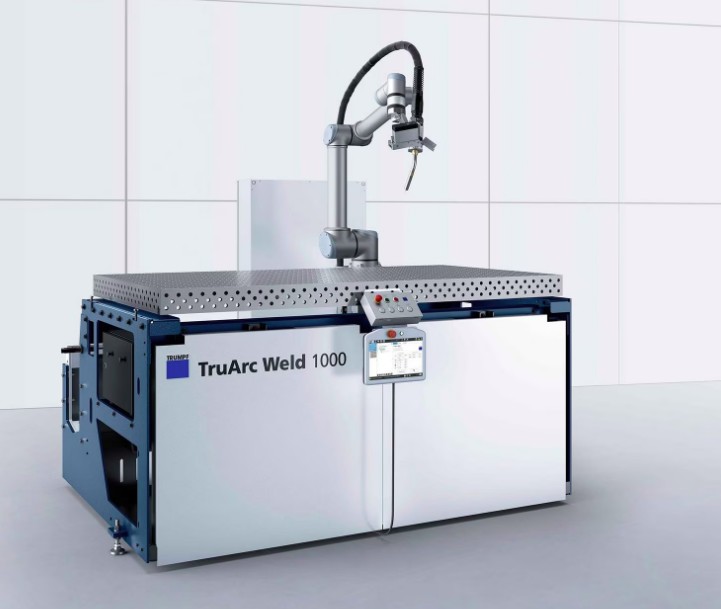 | TRUMPF Products Laser welding systems and arc welding cells Airprax Pneumatics LLP, Bangalore, offers TRUMPF make Laser Welding Systems and Arc Welding Cells designed for precise, efficient, and reliable... View product → |
Prove the choice with a production trial before committing
A brochure penetration figure cannot prove production suitability. Run the actual material combination, thickness range, joint design, shielding arrangement, fixture, and inspection method on competing equipment, then qualify the result under ISO 15614-11 for laser or electron-beam welding where applicable.
Industrial laser welding comparison
| Measure | Laser welding system | Arc welding cell |
|---|---|---|
| Cycle and quality | Fast on continuous, tight-fit joints; low first-pass yield if focus, gap, or shielding drifts | Slower on thin precision seams; larger weld pool tolerates gaps and filler |
| Defects and finishing | Burn-through, incomplete fusion, porosity, protective-window contamination, or fixture rework | Distortion, spatter, higher wire and gas consumption, and more grinding or cleaning |
| Production control | Sensitive to contamination, part location, and fixture repeatability | More tolerant fit-up; inspect recovery after wire, gas, or parameter changes |
Record the trial in a common sheet:
- Loading time, inspection time, cycle time, first-pass yield, penetration, and non-destructive or destructive test results
- Distortion, spatter, grinding or cleaning effort, wire and gas consumption, and other consumables
- Fixture sensitivity, changeover time, and recovery time after deliberate parameter drift
For a laser welding system versus arc welding cell for metalwork in Bangalore, accept the process that maintains qualified quality at the required batch size and takt time. Higher advertised power is not the decision; stable output with manageable recovery and finishing cost is.
Frequently asked questions
What is the main difference between laser welding and arc welding?
Laser welding concentrates heat into a narrow zone for fast, deep welds with limited distortion. Arc welding creates a larger weld pool suited to gaps, large fillets and higher filler-metal use.
When is an arc welding cell the better choice?
Choose an arc welding cell when parts have variable fit-up, wider gaps, heavy sections or large fillet welds that need substantial filler metal.
What should you check before choosing a laser welding system?
Check material thickness, joint design, allowable gap, surface condition, preparation method, clamping accuracy and the required production rate.
Why run a production trial before committing to a welding cell?
A trial verifies penetration, distortion, cycle time, weld appearance, fixturing, operator access and repeatability on your actual parts.