
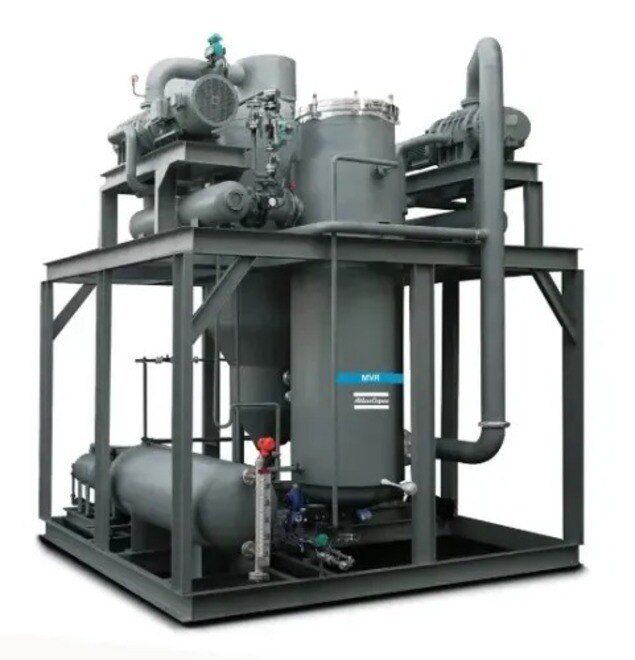
An MVR installation can replace much of an evaporator’s continuous steam demand, but its value depends on compressor power, temperature lift, liquor properties, operating hours and Bangalore electricity tariffs. You will be able to define the design data, estimate the real savings, compare competing evaporation methods and specify performance tests before selecting a system.
Key takeaways
- Measure liquor flow, solids, boiling temperature and vapor composition before sizing MVR.
- Compare compressor power against steam, cooling-water and maintenance requirements.
- Confirm materials, seals and vapor treatment match the chemicals in your process.
- Validate supplier calculations with a heat-and-mass balance and operating cases.
How MVR Recycles Vapor and Differs from Other Evaporation Methods
An evaporator boils the liquor and sends its vapour to a mechanical compressor. The compressor raises the vapour’s pressure and saturation temperature, then returns it to the evaporator’s heating side, where it condenses and supplies heat for further boiling.
An mvr system for chemical manufacturers therefore replaces much of the continuous steam supply with electricity, but pumps, controls, start-up heating and final cooling still consume energy.
| Option | What happens | When it applies |
|---|---|---|
| Steam heating | Fresh steam condenses on the heating side and the vapour leaves for a condenser. | Simple, flexible operation; useful when steam is inexpensive or load changes are large. |
| Thermal vapour recompression | A steam jet ejector entrains and compresses vapour using motive steam. | Plants with available high-pressure steam that accept ongoing steam consumption. |
| Multiple-effect evaporation | Vapour from one effect heats the next effect at a lower pressure. | Large, steady evaporation loads where extra effects justify their capital and space. |
| MVR | An electrically driven compressor raises process-vapour pressure and temperature for reuse. | High operating hours, stable loads and costly steam or cooling water. |
| Heat-pump evaporation | A refrigerant circuit or external heat pump transfers heat between separate loops. | Applications needing heat recovery without directly compressing the process vapour. |
Check boiling-point elevation before sizing. Salt, caustic or organic liquor can boil several degrees above the pressure-based saturation temperature, shrinking the available temperature difference and increasing compressor pressure lift. MVR also needs defined minimum turndown, bypass and steam or hot-water trim because low loads can destabilise suction pressure or cause compressor surge.
Which MVR Benefits Reduce Energy, Cost and Cooling Demand
The biggest benefit is replacing much of the continuously supplied steam with compressor electricity. The evaporated vapour is compressed, then condensed on the evaporator heating surface, reducing both steam consumption and heat rejected to cooling water.
| Benefit | What changes | What to verify |
|---|---|---|
| Steam reduction | Compressor electricity replaces evaporator steam | Motor load, pressure lift and operating hours |
| Cooling-water reduction | Less vapour reaches the external condenser | Start-up, excess vapour and non-condensables still need cooling |
| Operating-cost reduction | Lower energy use can offset added electrical demand | Electricity tariff versus steam and condensate-return cost |
| Capacity constraint | The compressor becomes a major connected load | Transformer, VFD starting, harmonics and standby-generator capacity |
These mechanical vapor recompression benefits in bangalore depend on the plant’s tariff and schedule, not on a generic percentage. MVR energy savings for factories become actual savings only when you compare the same production rate and product concentration.
Calculate annual baseline cost from steam consumed, condensate returned, cooling-water pumping and cooling-tower power. Calculate MVR cost from compressor and pump electricity, start-up or trim steam, cooling power, controls and maintenance. Then subtract MVR cost from the baseline cost and include operating hours, electricity demand charges and seasonal tariffs.
MVR does not eliminate cooling equipment: provide capacity for start-up, low-load operation, excess vapour and non-condensables. Check the result against the liquor’s boiling-point elevation, fouling rate and required turndown; unstable operation can erase an apparent energy benefit through cleaning time and lost production.
The Process Data Required for MVR Sizing in Bangalore
A single feed-flow figure cannot produce reliable mechanical vapor recompression sizing in bangalore. Provide the normal, minimum and maximum operating cases, because concentration, viscosity and boiling-point elevation can reduce heat-transfer capacity as the batch progresses.
1. State feed flow in kg/h, evaporation rate in kg/h, feed solids, target product solids, density and viscosity at each case. Include dissolved salts, caustic, organics and suspended solids.
2. Record boiling temperature, operating pressure or vacuum, allowable product temperature and boiling-point elevation. Give measured boiling data for concentrated liquor; pressure alone can understate the actual boiling temperature by several degrees.
3. Analyse the vapour: water or solvent fraction, corrosive components, condensable contaminants, non-condensable-gas load and expected vapour temperature. These values determine materials, compressor capacity and whether air removal equipment is needed.
4. Define the evaporator duty, heat-transfer coefficient, fouling tendency, allowable residence time, cleaning method, cleaning frequency and time required to return to production. A scaling liquor needs more design margin than clean water.
5. Specify compressor suction pressure, discharge pressure, pressure lift, temperature lift, required capacity and turndown. Show how these values change between startup, normal operation, concentrated product and the minimum stable load.
6. Add startup heat duty, final-condenser duty, Bangalore ambient design condition and electrical limits: transformer capacity, motor-starting method, variable-frequency-drive limits, harmonics and standby-generator capacity.
Attach laboratory or pilot data for the hardest feed case. A water-only test cannot prove performance on a corrosive, solvent-bearing or scaling chemical liquor.
Equipment Layout and Chemical Vapor Compatibility
An MVR system for chemical manufacturers normally includes an evaporator, vapour separator, compressor, condensate circuit, vacuum equipment, instrumentation and a backup cooling path. Layout these around short vapour lines and accessible cleaning connections; long, narrow lines increase pressure loss and compressor duty.
- Forced-circulation or falling-film evaporator matched to viscosity and residence-time limits
- Vapour separator with demister to protect compressor blades from entrained droplets
- Roots, centrifugal or screw compressor selected for vapour flow and pressure lift
- Condensate pump, level control and sampling point for recovered water or solvent
- Leak-tight vacuum system, controlled vent and non-condensable removal connection
- Start-up condenser or trim cooler for excess vapour and below-design operation
- Crystallizer, brine concentrator or solids-handling equipment when salts remain after water removal
Design for the actual vapour, not a water trial. Solvent vapours, chlorides, acids, alkalis and condensable impurities determine compressor metallurgy, elastomers, seals, hazardous-area classification, condensate segregation and the maximum compression temperature. Confirm compatibility before selecting stainless steel, nickel alloys or coatings.
Fouling changes the evaporator geometry, circulation velocity, heat-transfer area and cleaning cycle. Salt crystallization can block tubes and raise the boiling temperature; MVR does not remove dissolved salts. Air ingress, dissolved gases and volatile contaminants are non-condensables, not useful heating vapour.
They accumulate in the condenser, lower heat transfer and increase compressor volumetric load, so specify leak-tight equipment, a vent location and a measured removal rate. Use the separate condenser during startup, excess vapour and upset conditions.
How to Specify, Compare and Validate a Bangalore MVR Supplier
Do not approve a supplier on a water-only factory test. Require a signed performance guarantee for your actual liquor, stating feed composition, evaporation rate, suction pressure, discharge pressure, temperature lift, ambient condition, product concentration and turndown.
Before comparing quotations, request these documents:
- A design basis covering feed and product solids, boiling temperature, operating pressure, vapour composition, non-condensable-gas load, viscosity, fouling tendency, cleaning cycle, allowable residence time and product temperature.
- Compressor curves showing capacity, pressure ratio, motor power, discharge temperature and stable turndown at the guaranteed operating points.
- A heat-and-mass balance that identifies startup steam or heater demand, pumps, controls and final condenser duty.
- Materials, seals, hazardous-area classification and condensate-handling details for acids, alkalis, chlorides, solvents and condensable impurities.
- Acceptance-test procedures using representative liquor, with measurement points, instrument accuracy, duration and failure remedies.
Compare offers against evidence, not claimed efficiency.
| Criterion | Weak offer | Acceptable comparison |
|---|---|---|
| Performance test | Water-only test | Representative chemical liquor at guaranteed conditions |
| Energy claim | Compressor kW alone | Total kWh, including pumps, startup and final condensation |
| Temperature lift | Maximum ratio proposed | Area-versus-power trade-off with discharge-temperature limit |
| Turndown | Nameplate capacity | Stable operation across required load range |
Mechanical vapor recompression sizing in Bangalore must also include transformer capacity, motor starting or variable-frequency-drive behaviour, harmonic limits, standby-generation capacity and scheduled electricity tariffs. Airprax Pneumatics LLP can be evaluated on whether its proposal documents these interfaces rather than treating the compressor as an isolated package.
Sign the guarantee only after independent test data confirms mass balance, product concentration and total power consumption.
Frequently asked questions
How does mechanical vapor recompression differ from conventional evaporation?
MVR compresses the evaporated vapor, raises its saturation temperature and returns it as the evaporator’s heating medium. Conventional evaporation usually relies on fresh steam and sends vapor to a condenser or later effect.
Which data is required for mechanical vapor recompression sizing in Bangalore?
Provide feed and product flow rates, inlet and outlet solids, boiling temperature, vapor pressure, vapor composition, viscosity, fouling behavior, available steam, cooling-water conditions and operating hours.
How can an MVR system reduce energy and cooling demand?
The compressor reuses vapor heat, reducing the need for fresh heating steam. Because less vapor goes to a condenser, the system can also reduce heat rejection and cooling-water demand.
What should chemical manufacturers check before selecting an MVR system?
Check vapor corrosiveness, toxicity, flammability, crystallization, entrainment and fouling. Confirm compressor materials, seals, demister design, condensate handling, controls and cleaning access.
How do you validate an industrial vapor recompression supplier in Bangalore?
Ask for the heat-and-mass balance, compressor duty, pressure and temperature limits, power estimate, equipment materials, guaranteed performance points, layout drawings, commissioning scope and service plan.