
A press brake is only as productive as the match between its force capacity, tooling, material, controls, and support. By the end, you will be able to compare machines for Bangalore work, estimate forming requirements, and judge whether a sales-and-service package will protect accuracy, uptime, and operator safety.
Key takeaways
- Match tonnage and bed length to your thickest, longest regular workpiece.
- Verify bend angle, repeatability, safety functions, and documentation before handover.
- Use correct tooling, die openings, bend deductions, and springback compensation.
- Schedule maintenance for hydraulics, guides, tooling, controls, and safety systems.
How a press brake turns flat sheet into a controlled bend
The upper punch drives the flat sheet into a V-die, creating two angled legs around the bend line. Finished angle depends on ram position, die opening, punch radius, sheet thickness, material strength, and elastic springback.
In air bending, the sheet rests on the die shoulders rather than filling the die; therefore, one Y-axis position does not guarantee one fixed angle.
| Method | Practical role | Main trade-off |
|---|---|---|
| Air bending | Uses less force and flexible tooling | Requires springback compensation |
| Bottoming | Presses the sheet firmly into the die for better angle repeatability | Needs higher force |
| Coining | Forces the material deeply into the tooling | Uses the highest force and increases tooling stress |
For long bends, beam deflection can make the centre angle differ from the angles at the ends. Crowning, through hydraulic or motorized compensation or a crowned tool setup, counteracts that deflection and matters when tight tolerances apply.
Commissioning includes a test bend in the customer’s material and tooling, measured angle verification, and a program correction for springback. That sequence establishes the real process; it is not evidence of a defective machine.
Press brake support for fabricators in Bangalore should also document the correction, because later variation can come from thickness, material strength, tool wear, or programming rather than the press brake itself.
How to size the machine for Bangalore fabrication work
Size the press brake from the parts you will make, not from rated tonnage alone. Compare maximum bending length, rated tonnage, stroke, throat depth, open height, back-gauge axes, repeatability, minimum flange length, and compatible sheet thickness against your production drawings.
| Specification | What to compare | Why it matters |
|---|---|---|
| Maximum length and tonnage | Longest bend and available force | Prevents overload or unsupported work |
| Stroke, throat, open height | Ram travel, frame clearance, daylight | Determines deep boxes and multi-bend access |
| Back-gauge axes and repeatability | X, R, Z1/Z2 axes and measured return accuracy | Controls short flanges and batch consistency |
| Minimum flange and thickness | Smallest flange and material range | Rejects tools that cannot seat or clear the part |
Estimate force from material type, tensile strength, thickness, bend length, die opening, inside radius, and method—air bending, bottoming, or coining—then verify it against the manufacturer’s load chart. Do not apply a generic tonnes-per-metre figure when the load sits near one end, or when bottoming and coining require substantially higher force.
Electrical enclosures and HVAC panels need repeatable short and medium flanges. Lift components and structural brackets can require greater length, throat depth, or force; kitchen equipment rewards clean surfaces and controlled radii. Job shops need flexible tooling and capacity across materials and batch sizes.
Check minimum flange length and open height before ordering: a part must clear the punch, die, and frame throughout a multi-bend sequence. These checks are central to press brake bending machine sales and service benefits for fabricators in Bangalore because commissioning, tooling selection, and application support matter as much as capacity.
How material, tooling, and controls change bend quality
A correct program can still produce a different angle when tensile strength, material grade, thickness tolerance, rolling direction, grain direction, coating, or springback changes. Air bending leaves the sheet on the die shoulders, so identical Y-axis positions do not guarantee identical results; run a test bend, measure it, and enter the correction.
Choose tooling for the part, not only the machine. Standard V-dies suit general air bending; narrow openings suit thinner sheet and tighter radii, while wide openings suit thicker material and larger radii.
Radius tools form large inside bends, hemming tools fold edges, suitable punches provide clearance and access, and segmented tooling handles varied flange lengths or boxed profiles.
The upper tool, lower die, holders, and backgauges must share the machine centreline. A damaged or misaligned tool creates marks, asymmetric loading, inconsistent angles, and premature wear even when the CNC program is correct.
Entry-level versus higher-specification CNC capability:
| Option | What it provides | When the added cost earns its keep |
|---|---|---|
| Entry-level press brake | Basic axes, manual tool changes, operator-led corrections | Stable repeat work with trained operators |
| Higher-specification CNC | More back-gauge axes, angle measurement, automatic tool changing, and production automation | High mix, tight tolerances, frequent setups, or larger batches |
For buyers comparing bending machine service benefits in bangalore, ask whether setup support includes tool selection, alignment checks, angle measurement, and operator training. Sensors reduce repeated test pieces but cannot fix a wrong die, dirty datum, or incorrect bend sequence.
What a sales and commissioning package should prove before handover
A machine is not ready for production until a documented acceptance record proves it can make your parts safely and repeatedly. Local commissioning adds tooling selection, operator training, and troubleshooting; rated tonnage alone proves none of these.
Run test bends using the customer’s materials and chosen tooling, then measure springback and enter the correction in the CNC program. Record:
- Achieved angle tolerance and back-gauge repeatability
- Open-height and stroke suitability for the planned parts
- Hydraulic leakage, unusual noise, and vibration
- Operation of emergency stops, guards, light curtains, and two-hand controls where fitted
| Purchase basis | What you receive | What it proves |
|---|---|---|
| Rated tonnage alone | Capacity stated on the nameplate | The machine’s force rating, not part quality or safe production |
| Commissioned package | Representative parts, selected tools, trained operators, and recorded settings | The machine can produce your work under agreed conditions |
| Local support agreement | Troubleshooting, documented response, parts planning, and machine history | Faults can be diagnosed and resolved instead of repeatedly guessed at |
For press brake support for fabricators in Bangalore, ask who selects the tools, trains operators, attends breakdowns, supplies model-specific parts, and maintains the machine history. Ask Airprax Pneumatics LLP to identify part numbers, lead times, repair-exchange options, and obsolescence support for encoders, proportional valves, servo drives, and control boards.
A press brake maintenance provider in Bangalore earns its value only when response times, escalation contacts, and acceptance evidence are written into the handover documents. Without that record, material variation, tooling errors, and machine faults become indistinguishable.
Related products
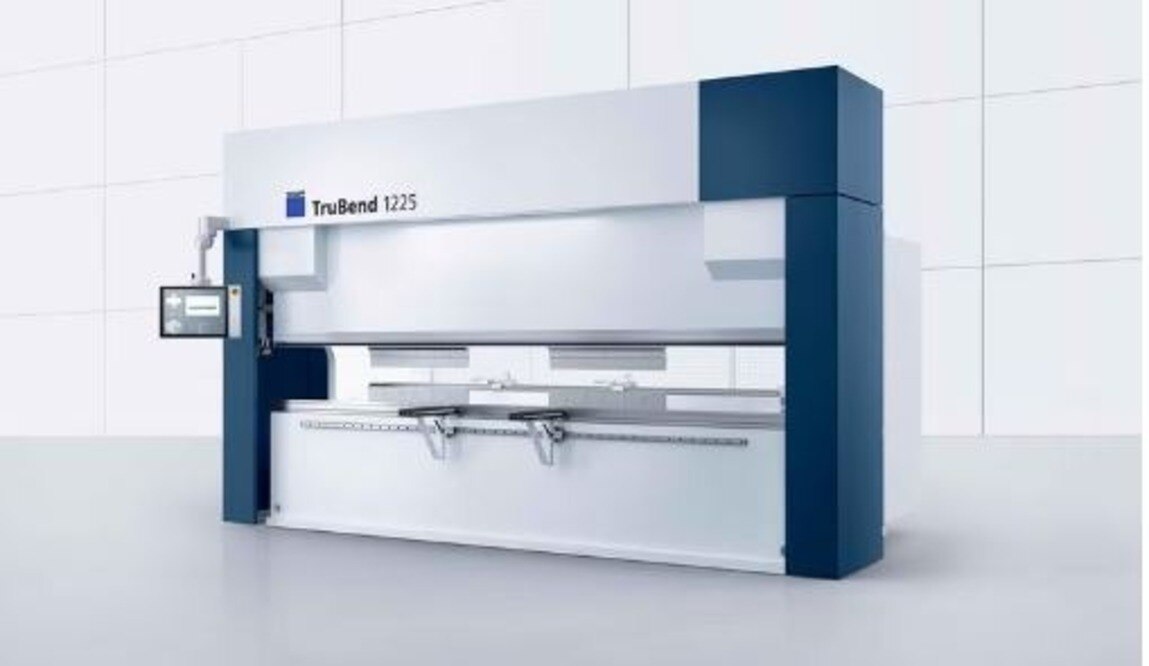
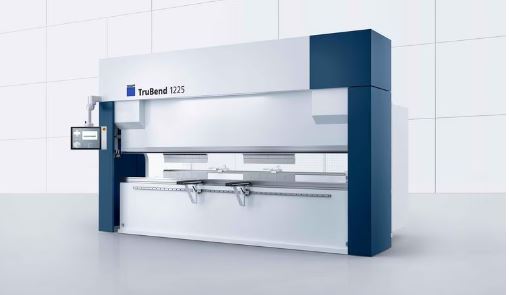 | TRUMPF Products Airprax Pneumatics LLP, Bangalore, is an authorized dealer for the TRUMPF TruBend Series 1000 Basic Edition, a reliable, entry-level press brake... View product → |
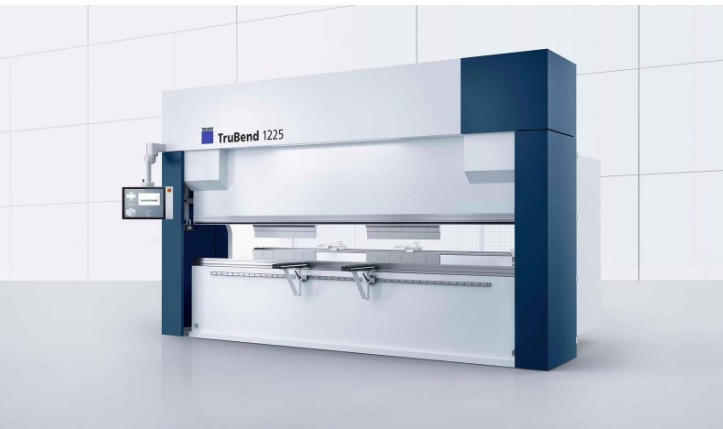 | TRUMPF Products Airprax Pneumatics LLP, Bangalore, offers high-performance TRUMPF make Bending Machines designed for accurate, efficient, and reliable sheet metal... View product → |
How preventive maintenance protects accuracy, uptime, and safety
A service visit should leave evidence, not just a signed job card. The measurable bending machine service benefits in Bangalore include fewer unplanned stops, stable angles, and a safer machine when technicians complete these checks:
1. Inspect hydraulic hoses, fittings, cylinder leakage, pump noise, filter indicators, oil temperature, and contamination. Clean, dry oil matters more than oil level: particles and water damage pumps, proportional valves, seals, and servo-hydraulic components.
2. Check guideways, every lubrication point, electrical-cabinet cooling, fans, terminal tightness, emergency stops, light curtains, and other fitted guards. Measure back-gauge repeatability and review alarm history for recurring axis faults, overheating, or angle drift.
3. If pneumatic clamps or blow-off are installed, record the required ISO 8573-1 air class in particle, water, and oil format, such as 2:4:2. Also state filtration stages, operating pressure, pressure dew point, and whether oil-free or specified oil-lubricated air is permitted; “shop air” is not a specification.
4. Use lockout/tagout before entering the hazard zone: isolate electrical supply, release hydraulic pressure, secure the ram against gravitational movement, and verify zero energy. Test the safety circuits after service.
5. Require a machine history recording oil and filter changes, replaced seals and valves, calibration, safety tests, software or parameter changes, and recurring alarms. Angle sensors compensate for springback, but they cannot correct wrong tooling, dirty datums, or a wrong bend sequence.
A reliable press brake maintenance provider in Bangalore can use these records to separate machine faults from changes in material, tooling, or programming.
Frequently asked questions
How does a press brake turn flat sheet into a controlled bend?
The upper punch drives the sheet into a V-die. Ram position, die opening, punch radius, sheet thickness, material strength, and springback determine the finished angle.
How do you size a press brake for Bangalore fabrication work?
Compare the machine’s tonnage and bed length with your material thickness, bend length, material strength, part dimensions, and regular production mix.
What affects press brake bend quality?
Material variation, tooling selection, die opening, punch radius, back-gauge accuracy, controls, ram positioning, and springback compensation all affect the result.
What should a sales and commissioning package prove before handover?
The supplier should demonstrate specified bend capacity, angle accuracy, repeatability, emergency stops, guards, control functions, operator training, manuals, and maintenance records.
How does preventive maintenance protect press brake performance?
Planned checks for hydraulic systems, guides, tooling, back gauges, controls, lubrication, and safety devices reduce accuracy drift, unplanned downtime, and operating risk.