
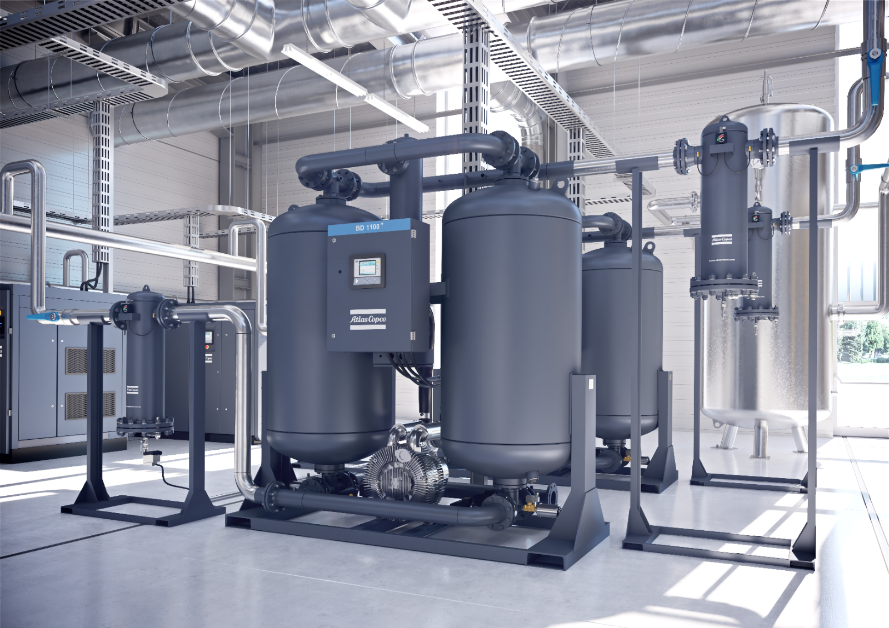
The general working principle of desiccant air dryers is simple: moist air flows over hygroscopic material (typical materials used are silica gel, molecular sieves, activated alumina) and is thereby dried. A desiccant dryer or an adsorption dryer is a piece of industrial equipment that uses desiccant materials to eliminated water from the air channeled through it. A standard desiccant dryer system uses a two-tower set up to ensure a continuous air drying cycle. In a desiccant dryer, adsorbing the water vapor onto the large, dry surface area of a highly porous material called desiccant dries the compressed air. This adsorption occurs as water vapor in the compressed air moves into the pores of the dry desiccant and is attracted to the surface of the pores. A desiccant air dryer system consists of two towers, one for drying the air and the other for regenerating the desiccant. The drying tower contains a porous desiccant material that inhibits water molecules as compressed air from the inlet passes over it.
A less common variant, the single tower desiccant air dryer, comprises a single tower containing a desiccant material that dries air coming in from the environment. Single-tower dryers also contain no mechanical parts and do not require electricity to operate. They are suitable for use in hazardous and corrosive environments. These instrument air dryers use a desiccant material, hygroscopic substances that exhibit a high affinity for water as the de-humidification agent. These types of compressed air dryers achieve a low dew point, making them suitable for use in colder climates and industries that require super dry air. There are three main types of desiccant dryer systems – heated, heatless, and heat of compression desiccant air dryers. Let’s take a closer look at these below.