
The right filter depends on what the air touches, not on a single pharmaceutical label or a micron number. By defining an ISO 8573-1 purity class, separating coalescing and adsorption duties, and placing sterile filtration at the actual use point, you can build a specification that protects both the process and the product.
Key takeaways
- Start with ISO 8573-1 particles, water and total-oil classes.
- Match coalescing, particulate, activated-carbon and sterile filters to contaminants.
- Install filtration where compressor, distribution and process contamination can enter.
- Verify the Bangalore installation with pressure, dew-point and oil-purity records.
Start with the required air purity, not a filter micron rating
Define the outlet purity before asking which air filter grade fits pharmaceutical compressed air in Bangalore. Use ISO 8573-1:2010’s three-part format: particles, water and total oil. A common starting specification for pharmaceutical compressed air filter selection is ISO 8573-1 [1:2:1].
| Target element | Specification |
|---|---|
| Particles | Class 1 |
| Water | Class 2, pressure dew point at or below −40 °C |
| Total oil | Class 1, at or below 0.01 mg/m³ |
ISO 8573-1 [1:2:1] is a practical starting point, not a universal legal requirement. Set the final class through process-risk assessment, product-contact requirements and the contamination limits for each operation. ISO 8573-1 does not establish sterility or microbial control.
Add a microbiological requirement or a validated sterile filter when air contacts product, product-contact surfaces or an aseptic process. Water class refers to pressure dew point, not atmospheric relative humidity.
Bangalore’s humid conditions and seasonal rain increase condensate risk; they do not change the selected ISO class, but they demand suitable aftercooling, water separation, drying, automatic drains and distribution design. Without those controls, condensation can recontaminate air after filtration and undermine the specified outlet purity.
Match each filter grade to the contaminant it can remove
Match the grade to the contaminant, not to the smallest number printed on the cartridge.
| Stage | Removes | Function |
|---|---|---|
| Aftercooler and water separator | Bulk liquid condensate | Cool compressed air and drain free water before fine filtration |
| Particulate prefilter | Pipe scale, rust, desiccant dust and larger solids | Protect downstream elements from solid loading |
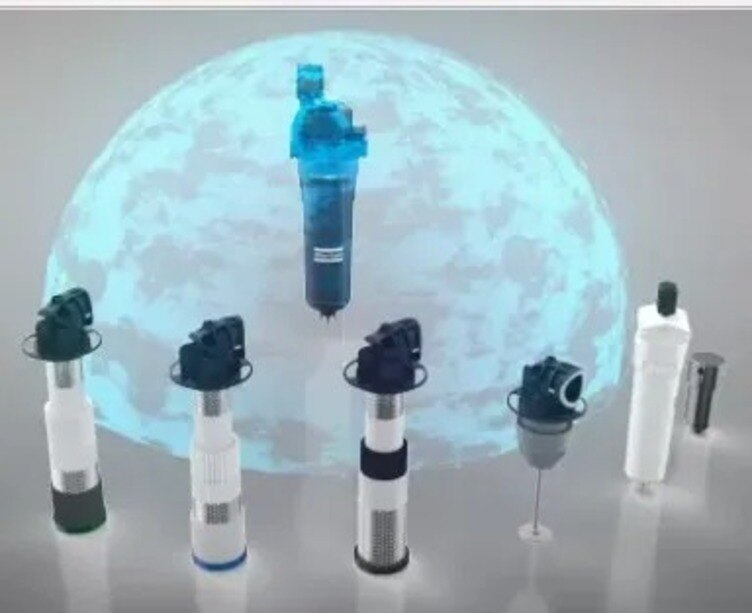
| Coalescing filter | Fine solids, liquid water and oil aerosols | Capture entrained droplets; it does not reliably remove oil vapour |
| Finer coalescing filter | Smaller water and oil aerosols | Protect demanding applications; specify pressure drop and loading capacity at rated flow |
| Activated-carbon filter | Oil vapour, hydrocarbon vapour and odour | Adsorb vapours that pass through coalescing elements |
| Sterile-grade membrane | Microorganisms | Filter aseptic gas at 0.2 or 0.22 microns with validated retention |
This is the functional map for pharmaceutical compressed air filter selection. ISO 8573-1 oil class covers liquid oil and oil aerosol, not oil vapour. Test oil vapour separately with an appropriate method and use activated-carbon adsorption when that contaminant matters.
A 0.01-micron compressed-air rating is not a sterilising-grade membrane claim. Require the rating basis, nominal or absolute status, efficiency, contaminant type, inlet conditions, rated flow, pressure drop and contaminant-loading capacity.
For microorganisms, require bacterial-retention validation and an integrity-test method suitable for the installed 0.2- or 0.22-micron membrane. A micron number without those documents does not prove sterilisation performance.
Place filtration according to where contamination can enter
Install filtration at four distinct locations, because each location controls a different contamination route. Good pharmaceutical compressed air filter selection separates compressor protection from delivered-air purification.
1. Compressor inlet filtration protects the compressor from ambient dust. It does not purify the compressed air leaving the compressor, so it cannot replace downstream filters.
2. Line filtration starts after compression, aftercooling and bulk water separation. Install particulate and coalescing stages here to remove compressor debris, pipe scale, rust, desiccant dust, liquid water and oil aerosols before air enters the distribution network.
3. Point-of-use filtration belongs beside the machine, regulator or hose. It controls contamination added by receivers, distribution piping, drains, dead legs, regulators and flexible connections after the main line filters.
4. Install the final sterile filter as close as practicable to the filling, coating, granulation or blowing station when gas contacts product, product-contact surfaces or packaging in an aseptic process. EU GMP Annex 1 requires gases used in aseptic processes to pass through a sterilising-grade filter at the point of use.
The final filter is not a permanent sterile barrier. Wetting, differential pressure, temperature, material compatibility, orientation, condensate and integrity testing affect performance. A long unvalidated hose or open blow-off point downstream can defeat the specification.
Use the same location logic for compressed air filtration for cosmetics: connect the filter grade to product or packaging contact, not to the industry label.
Choose the train from compressor type, process risk and operating data
Start with operating data, not the micron label. For pharmaceutical compressed air filter selection, record:
- Compressor type, operating pressure, peak and minimum flow
- Inlet conditions, pressure dew point and measured oil carryover
- Required particle size and whether air actuates equipment or contacts product
| Stage | Main target | Selection point |
|---|---|---|
| Aftercooler and water separator | Bulk liquid condensate | Install before fine filtration |
| Particulate prefilter | Rust, pipe scale and dust | Protect downstream elements |
| Coalescing filter | Liquid water and oil aerosols | Size for rated flow and pressure drop |
| Activated-carbon filter | Oil vapour, hydrocarbons and odour | Add when vapour contamination matters |
| Sterile membrane filter | Microorganisms | Use a validated 0.2- or 0.22-micron filter at aseptic point of use |
An oil-free compressor reduces compressor-oil contamination; it does not remove ambient particles, pipe scale, water or microorganisms, and the system can introduce oil downstream. Keep water separation, particulate protection and coalescing protection upstream. Add point-of-use sterile filtration when air contacts product or product-contact surfaces.
For compressed air filtration for cosmetics, use ISO 22716 as the GMP framework, then set controls by contact with bulk product, packaging surfaces, filling equipment or non-product-contact machinery. Do not copy an aseptic pharmaceutical specification automatically.
Specify clean and end-of-life differential-pressure limits, gauges or transmitters, automatic-drain performance, rated flow, replacement intervals and sampling locations. Tighter elements improve contamination control but increase pressure drop, energy use and low-pressure risk at the machine.
Turn the specification into a verifiable Bangalore installation
To decide which air filter grade for pharmaceutical compressed air in Bangalore fits, verify performance at the point of use, not only at the compressor outlet. Pharmaceutical compressed air filter selection is incomplete until commissioning proves the specified ISO 8573-1 class under operating flow and pressure.
1. Require a commissioning report naming sampling points at the compressor outlet, receiver, distribution branches, and representative filling, coating, granulation, and blowing stations. Record pressure and flow at every sample.
2. Test particles, pressure dew point, and total oil against the specified ISO 8573-1 classes. Define oil-vapour testing separately, including the method and reporting units; define microbiological testing separately rather than treating ISO 8573-1 as a sterility test. Use clean, dry, oil-free sampling equipment.
3. For a sterile filter, record bacterial-retention validation, membrane compatibility, installation orientation, operating temperature, differential pressure, and the integrity test required before or after use by the process. Document replacement criteria, batch records, and post-replacement checks.
4. Inspect automatic drains, low points, dead legs, receiver outlets, hoses, and point-of-use regulators. These locations can add water, particles, oil, or microorganisms after the compressor-room filter.
A systems provider such as Airprax Pneumatics LLP adds practical value when it reviews compressor selection, dryer capacity, filter sequencing, pressure drop, point-of-use installation, and test planning together. Name the ISO class, sterile requirement, test basis, flow, pressure, dew point, and maintenance limits in the purchase specification.
Related products
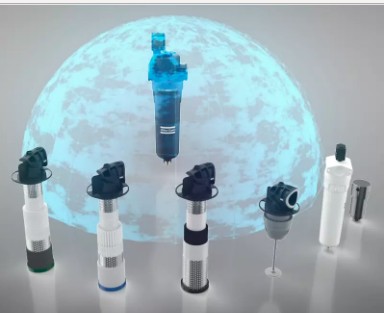 | Compressor Products Airprax Pneumatics LLP, Bangalore, offers high-quality Air Filters designed to provide efficient filtration of compressed air and protect pneumatic... View product → |
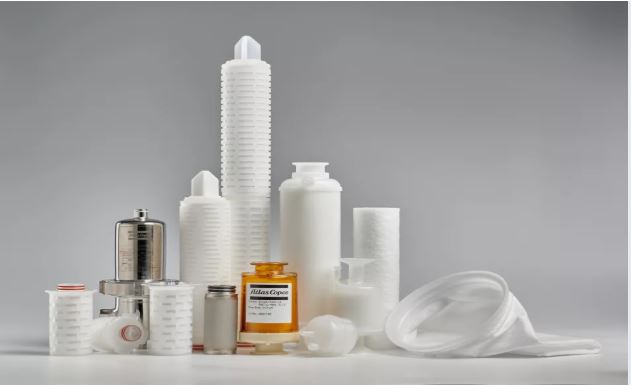 | Compressor Products We specialize in meeting the filtration and purification needs across diverse industries including Food & Beverage, Microelectronics, Pharmaceutical,... View product → |
Frequently asked questions
What air purity specification should pharmaceutical compressed air use?
Define particles, water and total oil under ISO 8573-1:2010. A common starting specification is ISO 8573-1 [1:2:1], but the process owner must confirm the required class for each point of use.
Which filter grade removes oil from pharmaceutical compressed air?
Use coalescing filtration for liquid oil and oil aerosols, then activated-carbon filtration when you need to reduce oil vapour. Confirm performance with outlet testing rather than relying on the filter name alone.
Where should compressed-air filters be installed?
Place filtration after the compressor and dryer, at branch points where contamination can enter, and near pharmaceutical points of use when the process risk requires final or sterile filtration.
How do you verify a pharmaceutical compressed-air filter installation in Bangalore?
Check the filter train against the specified ISO 8573-1 classes, record pressure drop and dew point, inspect drain operation, and retain particle, water and total-oil test results.