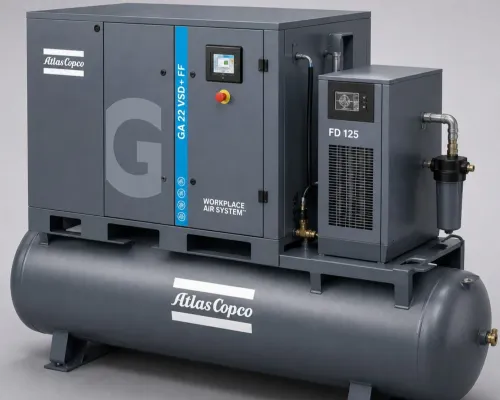

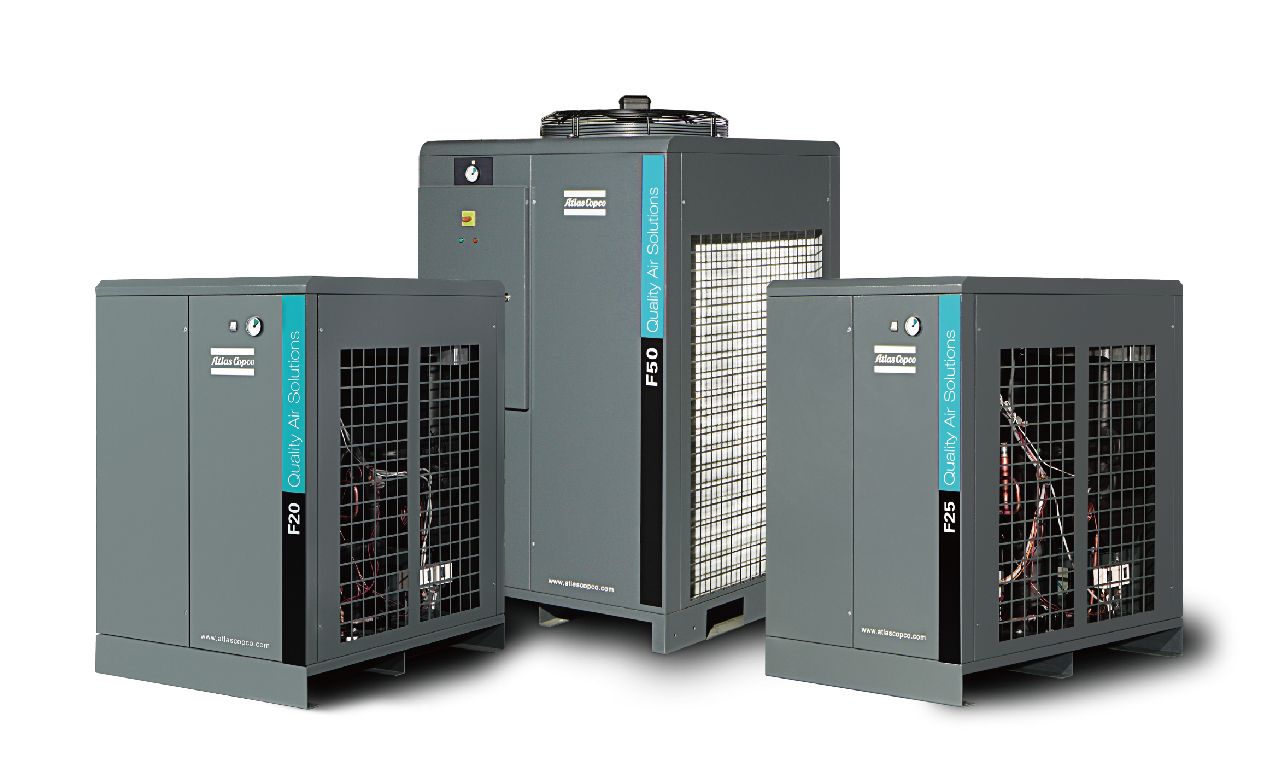
A refrigerant dryer uses a refrigerant circuit and heat exchangers to pre-cool compressed air, refrigerate it to condense the moisture in the air, and then re-heat the compressed air to prevent formation of the condensate on the pipe downstream. Refrigerant dryers can provide a pressure dewpoint (PDP) as low as +3°C / +37.4°F. They can be used at different pressures and consume no processed compressed air. In the first stage, compressed air enters the dryer and passes through an air to air heat exchanger, which precools the incoming air. In the second stage, compressed air passes through an air to refrigerant heat exchanger to reduce the compressed air dewpoint to + 3°C / + 37°F. Water vapor that was in the air condenses into liquid, which is trapped and removed. The dry air is then warmed up in the air to air heat exchanger to reduce the relative humidity in the air to prevent condensate from forming in downstream piping. A refrigerant air dryer has a compressor of its own that compresses the refrigerant gas to liquid form. Conventional refrigerant air dryers typically employ a reciprocating (piston) compressor operating at one fixed speed. In terms of energy efficiency, this results in the same “on or off” shortcoming present in a fixed speed air compressor. In contrast, a VSD refrigerant air dryer uses a scroll compressor with one spiral element orbiting around second, fixed element. It’s compact and quiet, and the inverter that drives the scroll element can vary speed to match demand. For compressed air systems to perform properly, the air must be dry. But ambient air gets hot when it’s compressed (you can’t change physics!) so when it exits the compressor, it’s 100% saturated with water. As the air cools, liquid water begins to condense. To protect air tools, keep air instruments reading and actuating properly, and prevent air piping from corrosion and leaks, the compressed air must be free of liquid moisture and at low relative humidity before it enters the air network. Filters and separators can remove liquid moisture droplets from a system, but they can’t remove water vapor. To remove water vapor to a low dew point, you need an air dryer. A popular drying method is refrigerant air drying.