
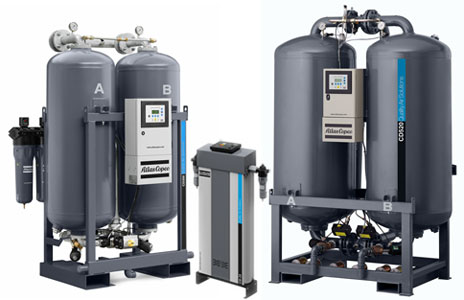
Air dryers remove moisture from the air. Each dryer system- desiccant dryer, refrigerated dryer, and membrane dryer, uses its own technique. The lower the temperature of the dew point, the less amount of water vapor in the air. Dew point means the actual temperature where condensation begins. A compressed air dryer is a piece of equipment designed to separate water vapor or moisture (de-humidify) from industrial process air. In the typical system, a compressor draws in humid air and compresses it, which raises the air temperature and then cooling the air condensing water vapor out of the unit. The basic function of the air dryer is to remove moisture from the air by cooling it with a refrigerant. Thus, the water vapor is condensed, and the air can be compressed. The result is dry compressed air, which can be used in compressed air equipment without causing any damage. The moisture content is higher in warm and humid air, which means that more water comes out of the compressor. The compressed air contains less water when the pressure is higher and the easier it can be dried. Think of a sponge that is soaked with water; the more it is squeezed, the less water it contains. Air dryers remove moisture from the air. The measurement of dry compressed air after processing is known as its 'dew point'. The lower the temperature of the dew point, the less amount of water vapor in the air. Dew point means the actual temperature where condensation begins. For example, if the dew point is -40 C° this means condensation starts only if compressed air temperature goes down to -40 C°. Water in a compressed air system often causes corrosion which leads to rust forming in the compressed air system. Those rust particles will be released and transported through the compressed air system. Corrosion of air or gas-operated instruments giving incorrect measured values, causing interrupts or switches off system processes.