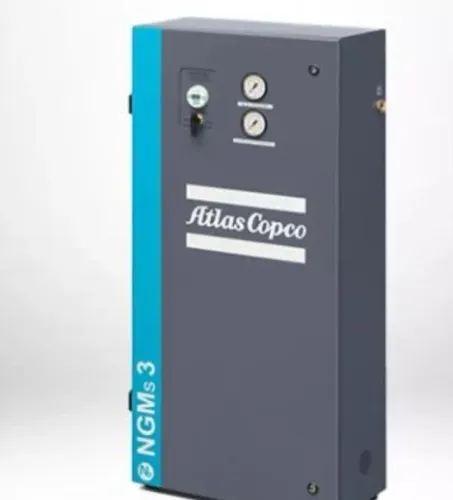
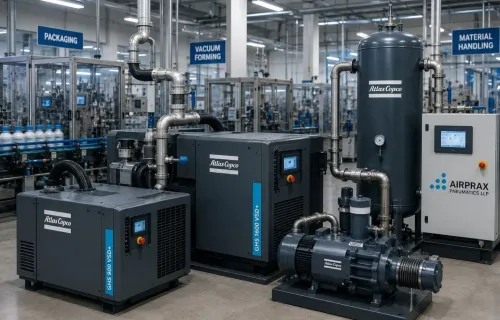
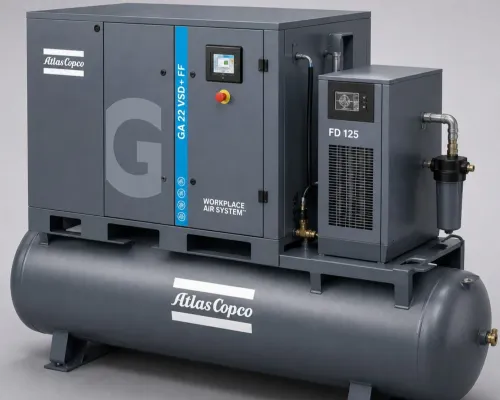
Desiccant dryers, sometimes referred to as absorption dryers, operate by absorbing water vapor into a porous media with a high affinity. The basic function of the air dryer is to remove moisture from the air by cooling it with a refrigerant. Thus, the water vapor is condensed, and the air can be compressed. The result is dry compressed air, which can be used in compressed air equipment without causing any damage. Desiccant Dryer is based on the principle of heatless regeneration and the physical properties of desiccant to adsorb and desorb the water Vapour. It uses pressure swing principle/purge air to generate the desiccant bed.
The Desiccant Dryer has two pressure vessels/towers filled with desiccant. While the air is dried in one tower/vessel, the desiccant in the other is regenerated, thus maintaining a continuous and automatic operation. Atmospheric air contains more water vapor at high temperatures and less at lower temperatures. This has an effect on the water concentration when the air is compressed. For example, a compressor with a working pressure of 7 bar and a capacity of 200 l/s that compresses air at 20˚C with a relative humidity of 80% will release 10 liters/hour of water in the compressed air line. Problems and disturbances can occur due to water precipitation in the pipes and connected equipment. To avoid this, the compressed air must be dried.

Bangalore
08048037607
+919742233402
 Chat with us
 Chat with us